Why Going Viral Can Kill Your Channel and How to Avoid It
Can going viral hurt your YouTube channel? Explore the risks of chasing a hit, losing focus, overspending and how to protect your creative direction.

The small model took a weekend. The next one took over the living room.
Imagine a creator who makes practical miniature-building tutorials. Their usual videos show inexpensive materials, visible mistakes, and projects a beginner could attempt. Then one unusually elaborate castle build becomes a hit. The comments ask for something bigger. The creator orders more materials, borrows another camera, and postpones the ordinary tutorial they had planned.
By the time the sequel is finished, the original audience has been waiting weeks. The creator is exhausted. The new video performs respectably, but below the breakout, which now feels like failure.
This is a fictional example, not a reported creator case. It illustrates how going viral can hurt a YouTube channel: a successful video can persuade its creator to adopt expectations, costs, and habits that the channel cannot sustain.
The danger is not an automatic algorithm penalty. It is making a series of decisions under the influence of an exceptional result.
The moment a successful experiment becomes an obligation
Before the hit, the castle was a special project. Afterward, the creator starts treating it as the minimum standard for every upload.
That change happens quietly. A simple tutorial begins to feel too small. A useful beginner question becomes less exciting than another dramatic reveal. The creator says, “People expect more now,” without specifying which people or what “more” means.
Some viewers may indeed want larger builds. Others may have appreciated the clear explanation, the resourcefulness, or the satisfying process. The comment asking for an enormous sequel is easier to notice than the silent viewer who liked learning a small technique.
The first decision after the hit should therefore be about the promise you want to repeat. Do you want to teach accessible miniature building, document ambitious art projects, or entertain through spectacular transformations? Those can overlap, but they lead to different production plans.
Choosing a new direction is legitimate. Drifting into one because the old plan suddenly looks unimpressive is harder to manage.

AI-generated editorial scene illustrating production overload. It does not depict a real creator or a reported event.
The view-count comparison that changes the story
Suppose the channel's last six comparable uploads reached 8,000, 10,000, 9,000, 12,000, 600,000, and 15,000 views in their first month. These values are hypothetical.
The final upload is far below 600,000. It is also above every earlier ordinary result. Calling it a collapse means choosing the outlier as the only relevant reference.
Keep both comparisons visible. The breakout shows what happened once. The surrounding uploads offer context for what has happened more routinely. Neither tells you exactly what the next video will do.
YouTube's performance guidance does not describe one disappointing video as a universal channel-wide punishment. Its Shorts guidance also says Shorts performance does not negatively affect long-form recommendations. Performance FAQ · Shorts discovery guidance.
That leaves a more useful investigation: what changed in the audience promise, upload choices, or production process? If every sequel now takes three times as long to make, the schedule has changed for an identifiable reason. You do not need an invisible penalty to explain it.
Put the workload beside the views
Our model-maker's normal tutorial takes six hours of active work: one for planning, two for building and filming, two for editing, and one for packaging and publication. The ambitious sequel takes eighteen: three, eight, five, and two hours respectively.
The new format is not just a more demanding edit. Building and filming have become the largest constraint. Buying a faster editing computer would not address most of that increase.
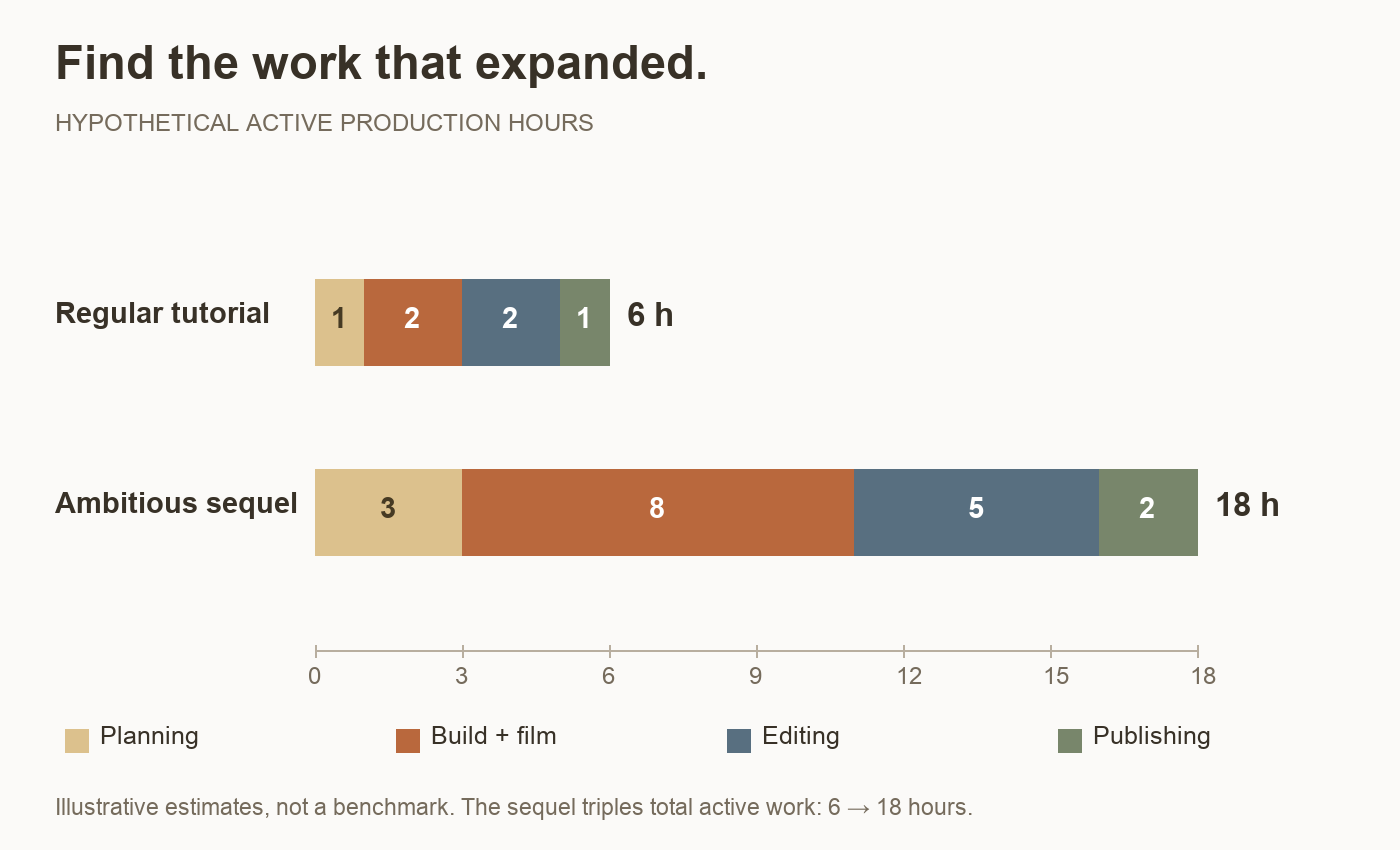
Invented production estimates: the chart helps locate the workload change. It is not an industry benchmark or a revenue forecast.
This simple accounting is more useful than asking whether the creator should “work harder.” It shows which part of the format needs redesign, help, or a longer schedule.
Count the hidden work too: sourcing materials, cleaning the set, replacing a failed shot, organizing files, and answering follow-up questions. You do not need to bill yourself by the minute. You need a realistic sense of what repeating the format would require.
If you have a job, school, family responsibilities, or limited filming space, those constraints belong in the plan from the start. They are not evidence that you lack commitment.
Make one ambitious video before committing to an ambitious channel
A one-off project and a recurring format should pass different tests.
A special build can justify extra effort because you value the experiment itself. A recurring format has to work when the result is ordinary, a supplier is late, or an edit needs another pass.
Before announcing a series, ask whether you can name several worthwhile episodes without continually increasing the scale. If every idea depends on “bigger,” “more expensive,” or “more extreme,” you may be building an escalation problem into the format.
For our creator, the better continuation might be a close-up lesson on making convincing stone texture. It carries a useful part of the castle build into an accessible project. It also gives viewers something new, rather than offering a smaller copy of the spectacle.
Another option is to publish the major builds occasionally and keep practical tutorials between them. That is a creative and operational choice, not a trick to appease a recommendation system.
Write down what makes the ambitious project special. If the answer is the story, the resourcefulness, or a surprising technique, those strengths may be repeatable at a smaller scale.
Protect one ordinary slot in the calendar
A breakout can consume every available planning conversation. Protecting space for ordinary work prevents one result from choosing the entire schedule.
The example below uses three production weeks. The first preserves a familiar core tutorial. The second contains a limited experiment related to the hit. The third is a review and recovery period rather than a promise to escalate again.
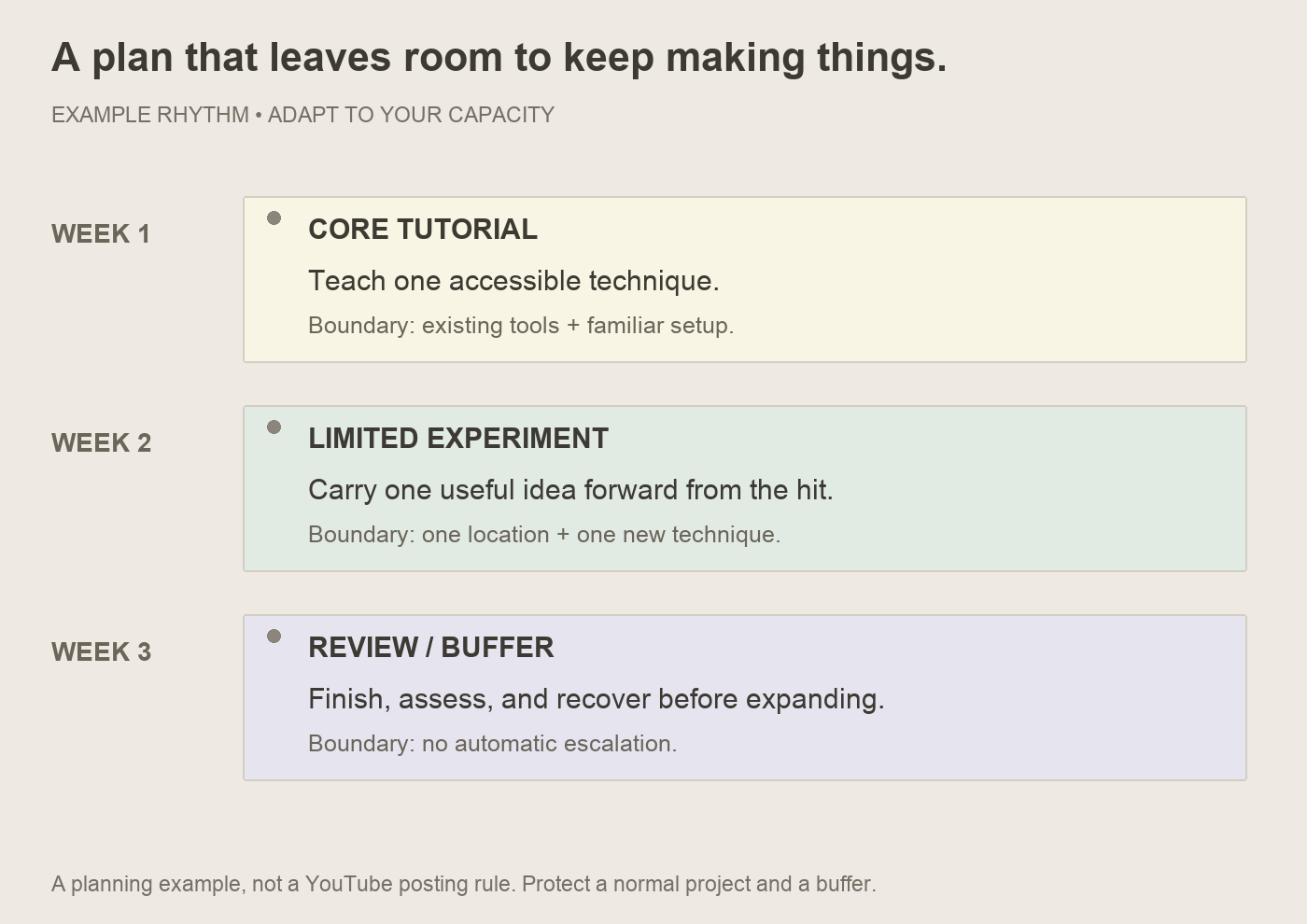
An example planning rhythm, not a recommended upload frequency. Adapt it to the actual hours and resources you have.
The boundaries matter as much as the ideas. “One location, existing equipment, one new technique” is a clearer experiment than “another big video.” It gives the creator permission to stop expanding the scope.
The ordinary slot also provides information. If the core tutorial still attracts the intended viewers, the channel has not suddenly lost all value because the viral audience was larger. If it does not, investigate the promise and recent audience context before abandoning the subject.
A buffer is useful work capacity. It gives you room to fix an explanation, finish a careful edit, or recover from an unexpected delay. A plan with no margin can turn one difficult production into several disappointing uploads.
Decide what to do with the new audience
The creator now has at least two possible groups: people who want approachable tutorials and people who want elaborate reveals. They may overlap, but the overlap should not be assumed.
Read the requests, examine the content people choose, and consider your own interest. You are allowed to decide that a spectacular build was an exception. You are also allowed to pursue the new direction deliberately.
What you should avoid is promising both groups an unlimited amount of content you cannot produce. A channel description and a clear series structure can help set expectations more honestly.
If the two directions are genuinely different, a second channel might eventually make sense. It also doubles some of the work: packaging, planning, audience communication, and maintaining another catalogue. It is not a repair button for one confusing month.
Try a bounded series before making a permanent organizational change. Several purposeful uploads will teach you more about the fit than an immediate rebrand prompted by one successful weekend.
Watch for the escalation in your titles
The change in strategy often appears in packaging before the creator admits it. A title moves from “Building a Castle From Cardboard” to “The Biggest Castle Ever” to another claim the video cannot comfortably support.
That is a useful warning sign. You may be increasing the promise faster than you can improve the experience.
Draft a version of the title that describes the actual interest: a material constraint, a visible technique, an unexpected failure, or a question the build resolves. If the video only seems worth watching when the wording exaggerates it, revisit the idea.
For a Short, the same pressure can appear as withholding the result, speeding past essential steps, or making a claim that the longer explanation later qualifies. The first impression should not depend on leaving out something that would change the viewer's understanding.
A better follow-up earns attention through a new piece of value. It does not need to persuade viewers that the previous video was merely a warm-up for something infinitely larger.
If you have already lost the original plan
Start with the last several uploads. For each one, write why you chose it and how much work it required. Mark the ideas you would still want to make if the viral video had never happened.
This is not an exercise in regretting success. It helps separate your own creative direction from decisions made to chase a particular number.
Next, name one audience you want to serve over the coming months. Be concrete enough to reject some ideas. “People who enjoy videos” cannot guide a schedule. “Beginners who want convincing miniature scenery from accessible materials” can.
Choose a small batch that serves those viewers. Include a familiar promise, a useful continuation of the hit, and room to learn before committing to more. Review the work as a batch rather than declaring the channel recovered or dead after a single upload.
There is no need for a grand apology unless you actually owe viewers a correction. A simple explanation of the upcoming work is usually more useful than a dramatic announcement about the algorithm.
Keep the success; reconsider the obligations
Our creator does not need to delete the castle video. The problem is the decision to make every future project exceed it. Removing the successful upload would not give back the hours already committed to an unsustainable sequel.
The more useful change is to define what continues: the craft, the explanation, the occasional ambition, and the audience the creator wants to help. The scale of one project can remain exceptional.
If you are deciding whether a particular upload should remain public, that is a separate keep-or-delete decision. If you want to help interested newcomers continue watching, focus on the next relevant video.
A viral hit can widen your options. It becomes dangerous when you mistake those options for obligations and let the most unusual result set the terms for all your future work.

The Psychology Behind Videos That Get Millions of Views
Explore the psychology of viral videos, from curiosity and emotion to clarity and payoff, with evidence-led ideas for YouTube Shorts and long-form content.
Read the post
Why YouTube Subscribers Matter Less Than You Think
Do YouTube subscribers matter? Learn what subscriber counts reveal, what they miss, and which audience metrics help you plan better Shorts and videos.
Read the post