Why Going Viral Doesn't Guarantee YouTube Channel Growth
A viral video brings attention, but what makes viewers return? Learn how to connect Shorts and long-form videos and turn a breakout into lasting growth.
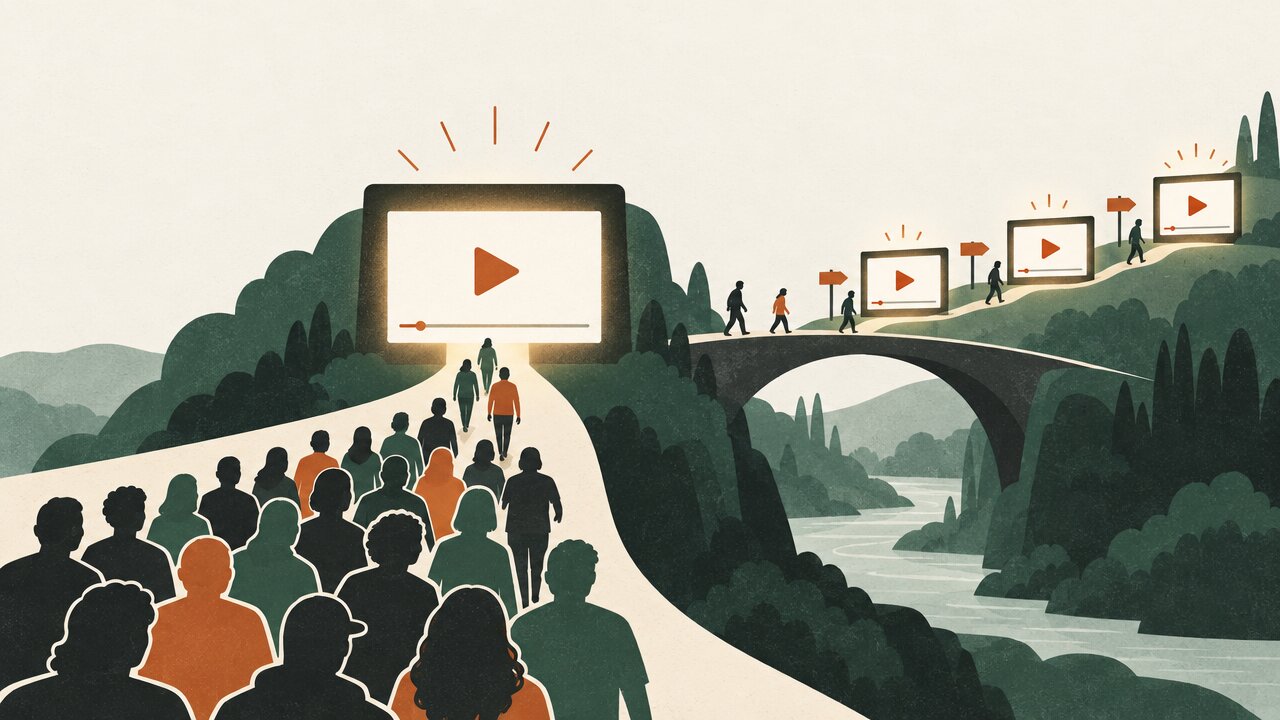
The plant-rescue clip was supposed to fill a gap between tutorials. It showed a drooping plant, a quick diagnosis, and the recovery. Then it reached people who had never watched the channel before.
For a few days, the creator's next move seemed obvious: make another gardening video. But the detailed watering lesson that followed attracted only a small part of the breakout audience. Had the momentum disappeared, or had the creator misunderstood what those people came to see?
This is a hypothetical channel, but the question is useful. Going viral gives a video an audience. Building a channel requires giving some of those people a reason to choose another video. A second choice cannot be assumed from the first.
Let's follow this gardening creator through the decisions after the hit. The aim is to build a useful continuation, not to force every casual viewer into a subscriber funnel.
The first mistake: treating everyone who arrived as the same audience
A plant rescue can attract several kinds of interest. One viewer wants to save a similar plant. Another enjoys dramatic before-and-after transformations. A third watches because the ending is satisfying, despite having no interest in gardening.
Those viewers can all be satisfied by the same Short. They do not necessarily want the same next video.
The creator's long watering lesson serves the first group most directly. A transformation compilation might appeal more to the second. Neither is automatically the right choice for the channel. The creator still has to decide whom they want to help repeatedly.
Read comments for clues, with restraint. “What should I check if the soil is already wet?” suggests a next practical question. “That reveal was incredible” suggests appreciation of the transformation. Commenters are a self-selected part of the audience, so their requests are useful leads rather than a complete survey.
Now compare those clues with the channel's purpose. If the creator wants to teach beginners to care for houseplants, practical questions should shape the continuation more than demands for increasingly spectacular rescues.
Give the next viewer a smaller, clearer step
The original follow-up was titled “A Complete Guide to Watering Indoor Plants.” It may be an excellent video. It also asks someone who enjoyed one quick rescue to commit to a much broader lesson.
A closer continuation could be “Drooping Plant? Check the Soil Before You Water.” It connects to the problem viewers just saw and promises a decision they can use immediately.
That title still needs an accurate video behind it. Different plants and conditions require different care; the creator should explain the scope rather than imply one diagnosis fits everything. The important editorial move is to address the next question raised by the first video.
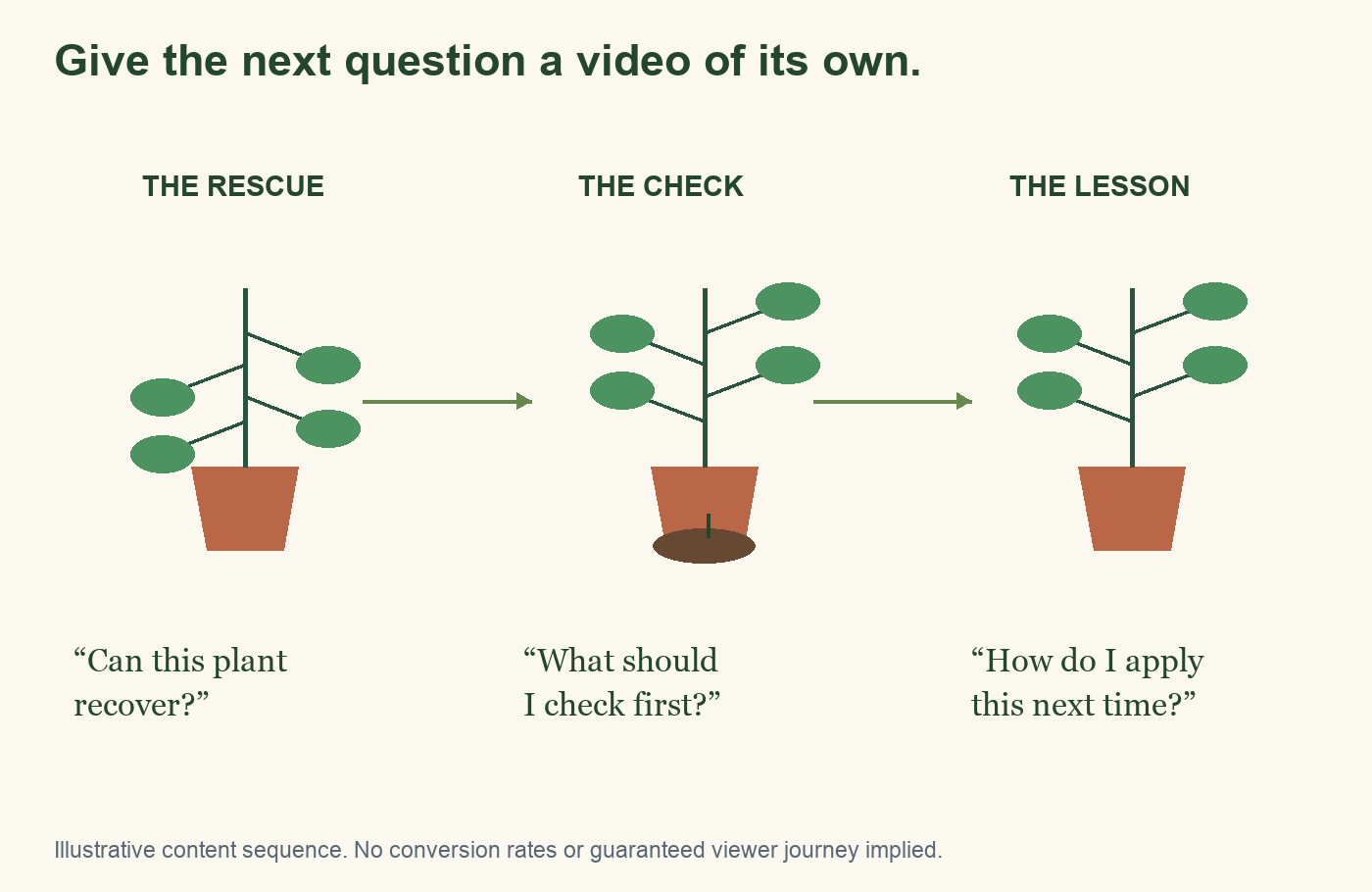
An illustrative content sequence. It shows possible next questions, not a measured conversion funnel.
The sequence lets the longer lesson earn its place. Someone who needs help interpreting the soil check has a concrete reason to continue. Someone who only wanted the satisfying rescue can leave having received a complete experience.
This is a more respectful and useful goal than trying to make every video incomplete so people must click another one.
Build a Short and a long video that belong together
A good pairing shares a viewer problem while giving each format a distinct job.
For the gardening channel, the Short might show a compact contrast: two similar-looking drooping plants, one with dry soil and one with wet soil. The lesson is that appearance alone may not tell you what action to take. The longer video can explain the checks, show limitations, and walk through several examples.
The Short needs its own payoff. It should not spend its whole runtime promising that the useful answer exists elsewhere. The longer video needs additional value. It should not simply repeat the Short more slowly.
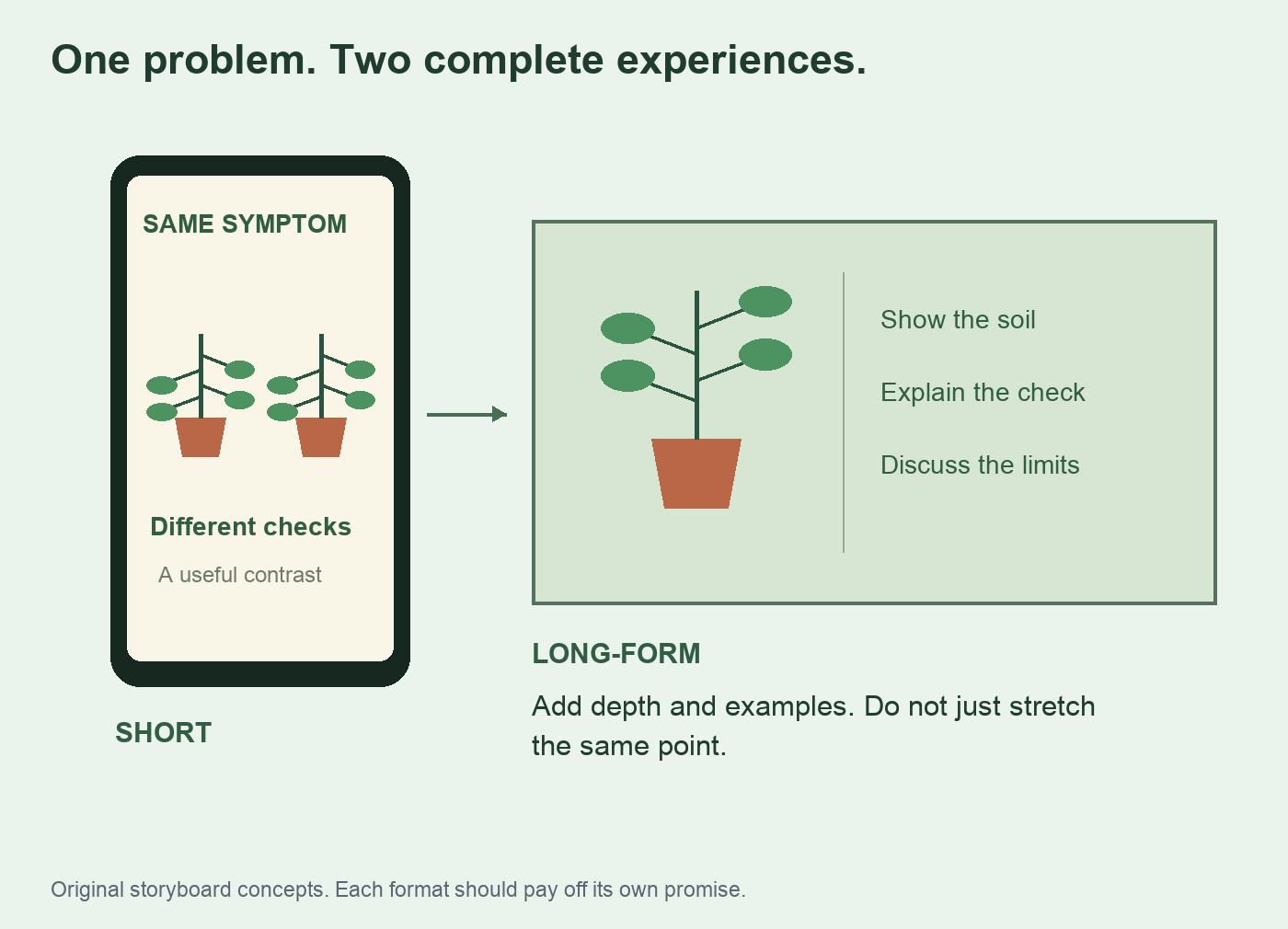
Original storyboard concepts, not screenshots of published videos. The format change adds depth rather than withholding the first video's answer.
YouTube provides a related-video link for Shorts, subject to advanced feature access. The selected destination must be public or unlisted. How to add a related video.
Use that route when the relationship is obvious. A natural invitation might be: “If both examples look like your plant, the full demonstration shows which checks to make next.” That tells viewers why the longer video exists.
A generic “watch my latest upload” ignores the moment in which the viewer is making the choice. The latest upload and the most relevant next upload are not always the same.
Find the useful continuation you already have
The creator does not necessarily need to film immediately. They may already have a short explanation of drainage or a beginner guide that answers the recurring question.
Review the catalogue from a new viewer's perspective. An old title might hide a relevant answer. A playlist may be organized by upload date rather than the order in which someone needs to learn. The channel homepage may emphasize an unrelated recent experiment.
Choose one destination that is both relevant and understandable. If it needs a clearer title, revise the promise accurately. If it is outdated, do not send a large new audience there simply because it exists.
For a long-form breakout, the same principle applies to an end-screen recommendation or a specific spoken suggestion. Tell people what the next video helps them do. A relevant continuation can be more useful than a broad introduction to the creator.
This is also a good moment to check the mobile experience. Can the title be understood quickly? Is essential thumbnail text readable at a small size? The connection should survive outside your desktop editing setup.
What the creator should measure after the excitement
The largest number remains attached to the rescue clip. That makes it tempting to use the hit as the standard for every subsequent upload.
Instead, ask three narrower questions. Did relevant older videos receive more attention? Did the planned continuation reach a stronger audience than comparable tutorials? Are more people returning over time?
YouTube identifies viral viewers who do not return as one possible explanation for a later decline in recommendation traffic. That is audience context, not proof that a hit caused a penalty. YouTube's performance FAQ.
Keep the viral upload separate in your notes so it does not dominate the channel-level totals. Compare similar video ages. A follow-up published yesterday should not be judged against a rescue clip that has been circulating for a month.
Also record changes in your own activity. If you published twice as many tutorials during the second period, some increase in total viewing may reflect that additional work. A useful analysis acknowledges more than one possible explanation.
The percentage trap: a smaller share can hide more returning people
Suppose our invented channel has 10,000 viewers in one period, including 2,000 returning viewers. In the next comparable period, the audience expands to 100,000 viewers, including 3,000 returning viewers.
The returning share falls from 20% to 3%. The returning count rises by 1,000. Both statements are true.
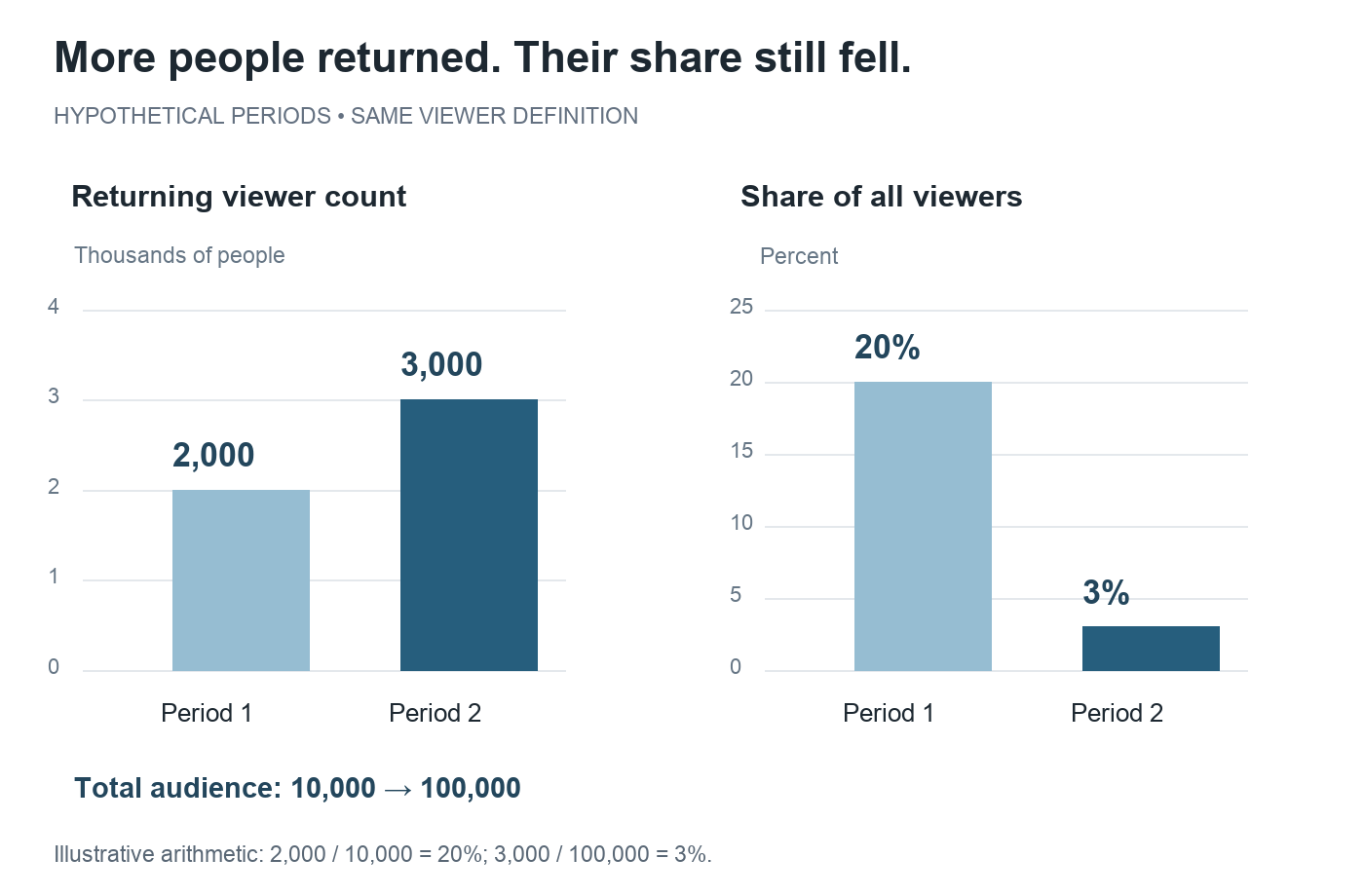
Illustrative arithmetic: 2,000 ÷ 10,000 = 20%; 3,000 ÷ 100,000 = 3%. The periods and values are invented, not a benchmark.
If you looked only at the percentage, you might conclude that the channel's relationship with viewers had weakened dramatically. The absolute count gives a different piece of the picture: more people returned, but new reach expanded much faster.
The reverse can happen too. A higher returning share can coincide with fewer total viewers. That might mean a dependable core audience alongside weaker discovery. It does not automatically mean the channel is healthier.
Write a plain-language interpretation beside the numbers. “Returning viewers increased, but most of the new reach remained concentrated in the rescue clip” is more informative than “loyalty collapsed.” It also points toward a possible next action.
Give long-term categories enough time to mean something
YouTube's monthly audience and viewer segments can help distinguish recent reach from a more established relationship. The regular-viewer category requires sustained viewing across more than six months in the past year. YouTube's viewer definitions.
A person who discovered the channel last weekend cannot immediately meet that standard through enthusiasm alone. Do not use a low regular-viewer share to declare a newly acquired audience a failure.
In the short term, investigate whether the proposed continuation is useful. Over a longer period, look for repeated interest in the subject or series you intend to keep making.
Avoid treating every adjacent rise as a verified viewer journey. Seeing both the Short and the tutorial gain views does not prove that every additional tutorial viewer came through that Short. Use the attribution and traffic-source information available in Studio, and be explicit about what remains uncertain.
The next three uploads need a purpose, not a chase
Our gardening creator could publish a focused soil-check lesson, a familiar core tutorial, and another compact diagnosis demonstration. This is one possible sequence, not a required posting ratio.
The focused follow-up tests whether the practical interest behind the rescue extends further. The core tutorial keeps serving the established audience. The new demonstration tests whether the channel can repeat the useful format with a different problem.
Before filming, write the connection in ordinary language. “People who watched the rescue may need help deciding what to check first” is a stronger brief than “Make something viral again.”
Keep production demands manageable. If the first hit depended on weeks of filming a recovery, do not promise a similar transformation every day. A sequence of clear, relevant lessons may give the audience more reasons to return than an unsustainable schedule of spectacular reveals.
After the batch, review the results together. One modest follow-up is not enough to prove that the new audience was irrelevant. Equally, one successful sequel does not mean every future upload should become a rescue video.
A breakout can be valuable without becoming your whole channel
Some people will watch the rescue once and never return. That does not erase the enjoyment or useful information they received. Not every satisfied viewer becomes a long-term audience member.
The creator's task is to make a relevant next choice available to the people who want it, then continue producing work that makes sense for the channel. That leaves room for both discovery and continuity.
When studying how other channels handle this, the Growwly Chrome extension can support on-page research and AI-assisted questions. Look for how the videos connect, rather than assuming public counts reveal private audience journeys.
The rescue clip opened a door. The soil check and watering lesson give a particular viewer a reason to walk further. That is the part of growth the creator can design deliberately.

The Psychology Behind Videos That Get Millions of Views
Explore the psychology of viral videos, from curiosity and emotion to clarity and payoff, with evidence-led ideas for YouTube Shorts and long-form content.
Read the post
Why Going Viral Can Kill Your Channel and How to Avoid It
Can going viral hurt your YouTube channel? Explore the risks of chasing a hit, losing focus, overspending and how to protect your creative direction.
Read the post