The Psychology Behind Videos That Get Millions of Views
Explore the psychology of viral videos, from curiosity and emotion to clarity and payoff, with evidence-led ideas for YouTube Shorts and long-form content.

“Today I'm going to share some tips to help you make better videos.”
There is nothing false about that opening. There is also very little to become curious about. The viewer has a broad topic, an unspecified benefit, and no evidence that the next few minutes will be worth choosing.
Now try another opening: “These two clips use the same phone in the same room. Why does one look so much better?”
The second version gives the viewer something to inspect and a question to resolve. That does not guarantee millions of views. It does show how the psychology of a viewing decision can change through a concrete creative choice.
This article is a workshop: we will build a video about window lighting, examine the decisions inside it, and use research to clarify what we can reasonably infer. No universal hook formula or invented attention-span rule is required.
Begin with something the viewer can judge
Our hypothetical creator wants to help beginners improve phone video at home. The initial idea is “Better Smartphone Video.” The problem is not a shortage of tips; it is that the promise is too broad to picture.
Choose one situation instead: a person records beside a window, dislikes the result, and assumes they need a new camera. The video will demonstrate how changing the position can change the image under the conditions shown.
The opening can now show two clips before explaining the setup. Keep the person, phone, and relevant settings consistent, and disclose what changes. A fair demonstration matters more than making the contrast as dramatic as possible.
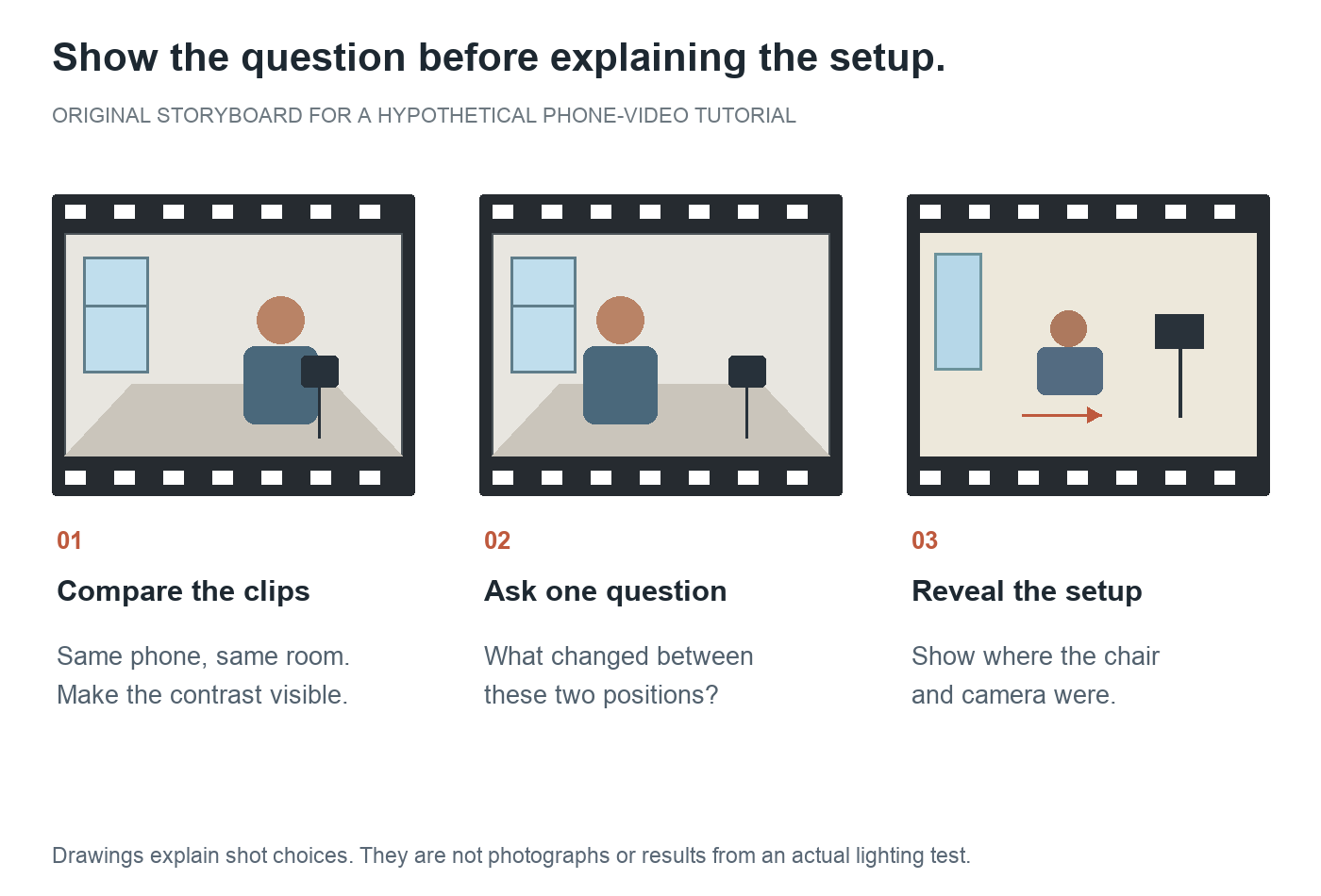
Original storyboard for a hypothetical tutorial. The drawings illustrate shot choices, not photographs of an actual lighting test.
The viewer can see the question rather than merely hear a claim that the topic is interesting. The wide shot then gives them a way to understand the answer.
This is a useful principle for many subjects. A sound tutorial can let people hear the difference. A repair video can show the fault. A comedy sketch can establish the awkward situation. Start with something the intended viewer can recognize or evaluate.
Curiosity needs enough information to become specific
A vague mystery asks people to care before explaining what is at stake. “You won't believe this” could introduce almost anything. “The camera stayed the same; the position changed” gives a viewer a manageable gap in understanding.
Kang and colleagues studied curiosity during trivia questions and found relationships with reward-related activity and later memory. The work helps explain why a meaningful question can support learning, but it did not test YouTube openings or establish a fixed deadline for hooks. Read the study.
Our creative application is a hypothesis: if the viewer understands the contrast and wants the result, they may be more interested in the explanation. We still need to test the video with actual viewers.
Notice how much information the opening gives away. It identifies the equipment, the location, and the visible outcome. It withholds only the explanation. That makes the question easier to enter than a sentence designed to hide everything.
You can use this when revising a title too. Ask what the viewer already needs to know in order to care. Mystery is not improved indefinitely by removing context.
Edit the opening for useful information
Here is a plausible first draft:
“I've been wanting to make this video for a while because a lot of people ask about my setup. Before we start, remember to subscribe. Today I'll show you a really important trick that makes a big difference.”
The creator is speaking, but the viewer has not yet received the demonstration, the specific problem, or a reason to trust the promised difference.
A revision could read:
“Same phone. Same room. In the second clip, I moved beside the window. Here's where the camera and chair were in each shot—and when this change won't give you the look you want.”
The revised version still needs the actual shots. A sentence claiming a comparison is not a substitute for showing one. It also avoids claiming that one setup is best for every room or creative goal.
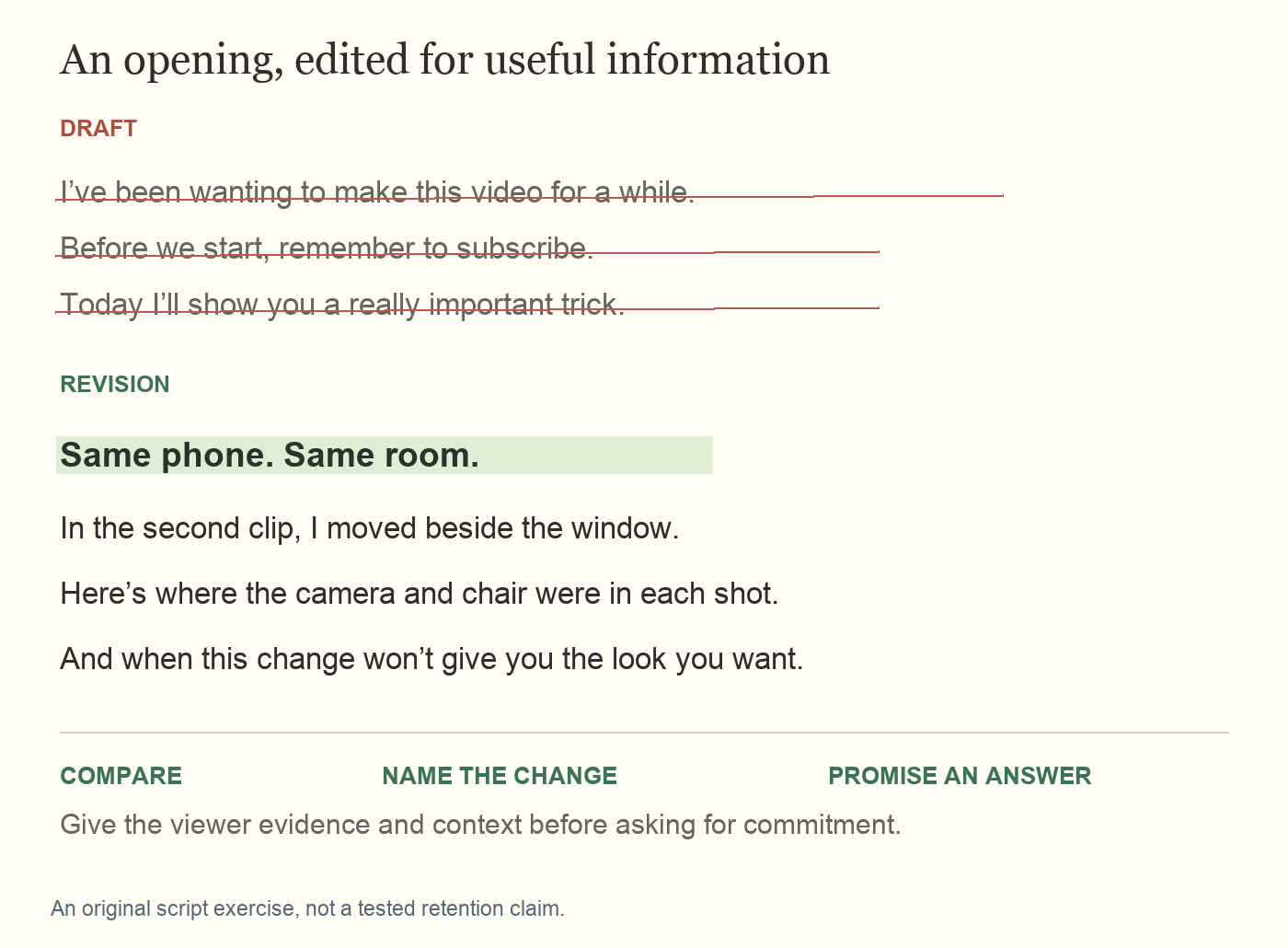
An original script exercise. The annotations explain the edit; the revision has not been tested for retention or reach.
Read the two versions aloud. The difference is not just speed. The second contains more information relevant to the reason someone chose the video.
That distinction matters when creators mistake frantic editing for engagement. A fast sequence can still be empty. A slower demonstration can remain compelling if the viewer is learning something they wanted to understand.
Give the emotion somewhere honest to come from
The lighting tutorial's emotional payoff is modest: relief that an improvement may be possible without buying a new phone, or satisfaction at understanding a confusing result. It does not need manufactured panic about “ruining every video.”
Other subjects support different emotions. A restoration can offer anticipation and relief. A scientific demonstration can create surprise. A precise joke can make someone feel recognized.
Berger and Milkman's research linked sharing with emotional activation, including differences between high-arousal and lower-arousal emotions. Its setting was news content and experimental tasks, not a direct test of modern YouTube distribution. Read the research.
For our workshop, the useful question is: what should the viewer feel after seeing the evidence? Then inspect whether the actual sequence can create that experience.
If you want the viewer to feel capable, include enough detail to try the change. If you want surprise, establish the expectation before revealing the contrast. If you want amusement, make the situation legible before adding the complication.
Music and pacing can support the experience. They cannot supply a meaningful result that the footage never demonstrates.
Make the explanation easier to follow than your production process
You may have tried seven positions, changed settings, moved furniture, and reshot the comparison. The audience does not necessarily need to encounter those events in the order they happened.
Organize the explanation around the viewer's question. Show the comparison, reveal the two positions, explain what the light is doing, and discuss the limits. Include a failed attempt if it clarifies a mistake people might otherwise make.
Introduce one important distinction at a time. If you mention exposure, direction, contrast, and background separation in the same sentence, a beginner may not know which part of the frame to inspect.
A useful edit can pause on the image and point to the relevant feature. A wide shot can establish the room before a close-up examines the face. The purpose is to reduce avoidable confusion, not remove every demanding idea.
For global viewers, avoid relying entirely on a metaphor, idiom, or local reference to explain the change. Clear visual evidence can travel further than an unexplained phrase. Captions and spoken context should reinforce the same point rather than compete for attention.
The payoff is a promise you can check
Our opening asks why two clips look different. By the end, the viewer should understand what changed, see enough evidence to evaluate it, and know something about when the advice applies.
That gives us a concrete editing test. Does the final sequence actually answer the original question? If the video ends with a general speech about creativity, the answer may still be missing.
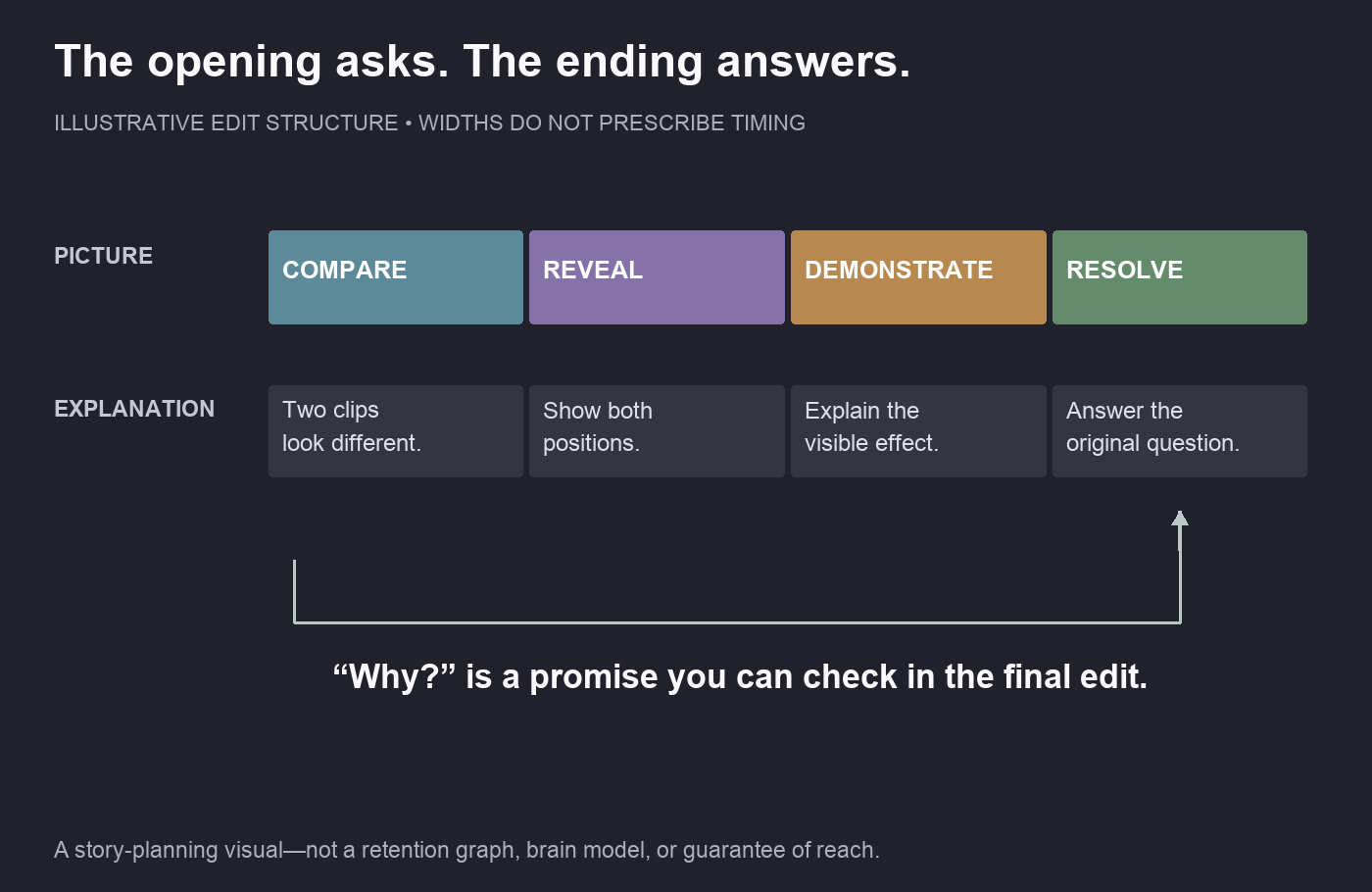
Illustrative story structure, not a retention chart. Segment widths do not specify an ideal duration.
A long-form video can include smaller resolutions along the way. Show one position, explain the visible effect, then move to the next question. Progress becomes understandable because something is resolved at each stage.
A Short needs a compact version of the same honesty. It can show one contrast and one practical takeaway. The longer companion can add examples and exceptions. Do not leave the Short deliberately unintelligible just to push people elsewhere.
An elegant loop is optional. A comprehensible payoff is part of the promise you made.
Why a polished video can still remain small
At this point, our tutorial has a clearer opening, a useful demonstration, and an honest answer. It may still receive modest reach. That does not automatically make the psychological reasoning wrong.
The topic may have a limited audience, the distribution context may differ, or competing videos may be more appealing to particular viewers. The creative decisions improve a specific experience; they do not control every condition under which it is discovered.
Research on an artificial music market by Salganik, Dodds, and Watts found that stronger social influence increased both inequality and unpredictability in success. The experiment concerned music choices, so it should not be presented as a model of YouTube's algorithm. It is a useful reminder that popularity is not a perfectly readable ranking of creative quality. Read the paper.
When you study a million-view video, look for ideas worth examining without assuming every choice in it caused the result. A weak joke can exist inside a successful video. A thoughtful demonstration can exist inside an overlooked one.
Turn the next upload into a useful learning attempt
Before filming, write one expectation you can investigate. For our tutorial: “Showing the contrast before the introduction should make the question easier to understand.”
After publishing, look at the opening alongside the available retention information. Read comments for signs of confusion about the setup. If viewers ask whether you changed the camera, perhaps the comparison needs clearer explanation. If they ask how to adapt it to a room without a large window, that may be a useful follow-up subject.
Do not claim that one before-and-after result proves the edit worked. The audience, topic, timing, and packaging may also differ. Repeated observations are more useful than a confident verdict after one upload.
For Shorts, inspect the relevant viewing measures in Studio rather than equating public starts with satisfied attention. A replay might mean delight, confusion, or a missed detail; the count alone cannot settle the interpretation.
Keep a short note about what you would preserve in the next version. You are building a creative practice, not a collection of universal rules.
Use psychology to make a better promise
The revised lighting video does not need a claim that it activates a particular brain chemical or exploits a precise attention threshold. It needs an observable question, evidence that answers it, and an explanation the intended viewer can follow.
That is why the best lesson from the workshop is specific: replace vague enthusiasm with a visible comparison; replace unnecessary setup with useful context; replace a delayed answer with progress the viewer can recognize.
A million views would be a welcome outcome. The work you can actually do is make the next person's decision to watch feel worthwhile.

Why Going Viral Can Kill Your Channel and How to Avoid It
Can going viral hurt your YouTube channel? Explore the risks of chasing a hit, losing focus, overspending and how to protect your creative direction.
Read the post
Why YouTube Subscribers Matter Less Than You Think
Do YouTube subscribers matter? Learn what subscriber counts reveal, what they miss, and which audience metrics help you plan better Shorts and videos.
Read the post