Why YouTube Subscribers Matter Less Than You Think
Do YouTube subscribers matter? Learn what subscriber counts reveal, what they miss, and which audience metrics help you plan better Shorts and videos.

Which channel would you rather run: one with 80,000 subscribers or one with 8,000?
Most creators would take the larger number before asking anything else. Now add one more detail: the larger channel has 6,000 viewers in a recent 28-day period, while the smaller one has 12,000. The choice becomes less obvious.
These are invented channels, and neither number tells the whole story. That is the point. Subscriber count records accumulated interest. It does not, by itself, describe the audience currently choosing your videos.
To understand what subscribers actually mean for YouTube growth, let's read the two channels more carefully. The exercise will also show why replacing subscriber obsession with a different favorite metric does not solve the problem.
Meet Channel A and Channel B
Channel A has been publishing for years. Its archive includes several popular tutorials, but its subject has changed twice. Channel B is newer and makes a focused series of beginner lessons. Neither history is inherently better.
For our hypothetical comparison, Channel A has 80,000 subscribers and 6,000 monthly viewers. Channel B has 8,000 subscribers and 12,000 monthly viewers. We are using the same recent window for both audience figures.
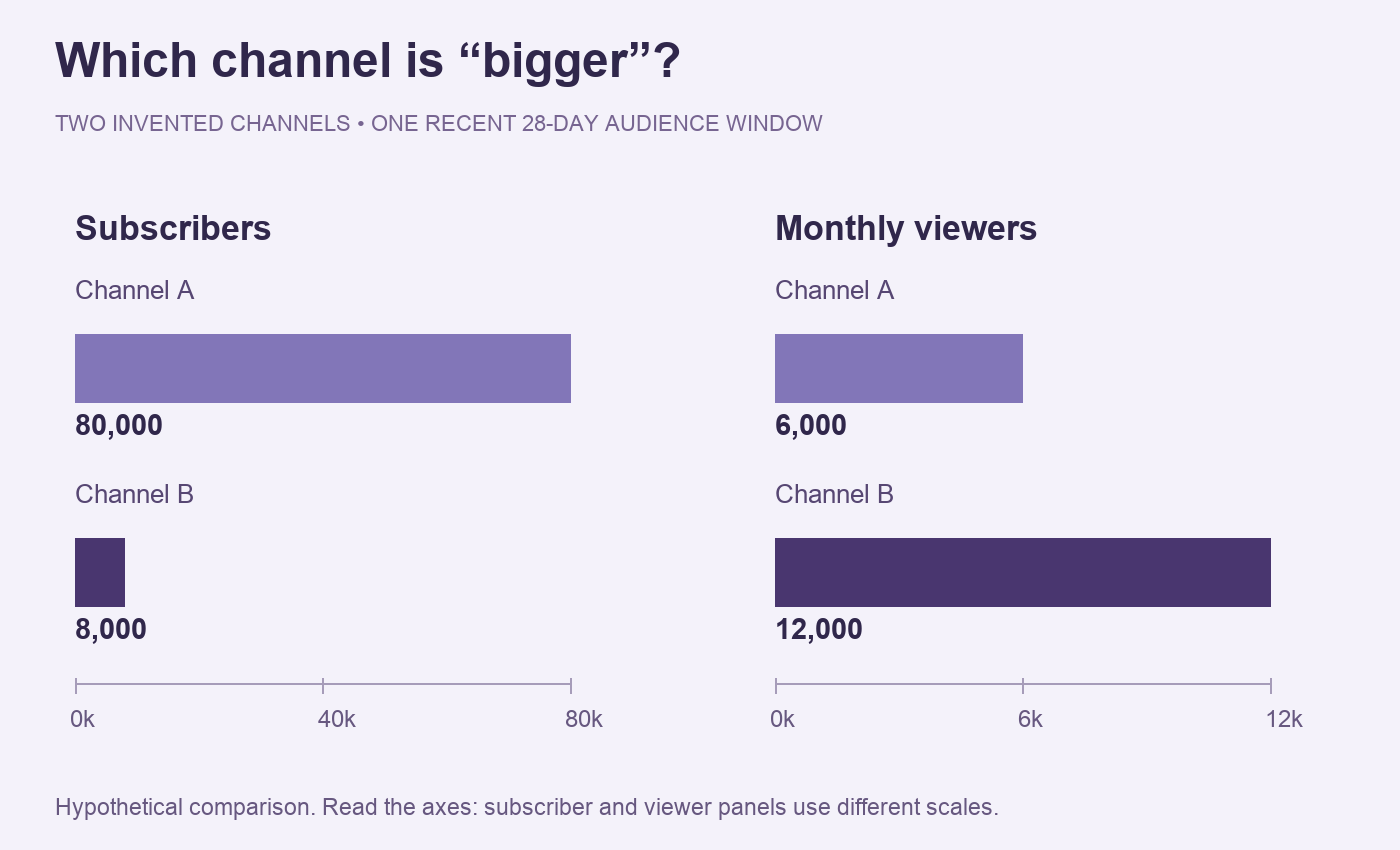
Invented values for a reading exercise. Bar lengths use the same scale within each panel; the panels have different scales, shown on their axes.
Channel A is larger by subscriptions. Channel B has more active reach in this period. We still do not know who enjoyed the videos, whether people returned, how much work production required, or what either creator wants the channel to accomplish.
YouTube explicitly distinguishes subscribers from an active audience and recommends monthly audience as a more useful estimate of current audience size. YouTube's audience guidance.
The practical lesson is to finish the sentence whenever you call a channel “bigger”: bigger by which measure, over what period, and for what purpose?
A subscription and a view are different actions
A person may subscribe after one useful repair tutorial and have no reason to watch another repair for months. Another may enjoy a creator's videos whenever they encounter them without subscribing. A third may have liked the old subject but not the new one.
None of those behaviors requires a mysterious explanation. People have changing needs, limited time, and many alternatives.
A subscription is a useful expression of interest, but the next upload still has to make sense to that person. If you promise beginner audio advice and then publish a long travel vlog, an earlier subscription does not make the vlog relevant.
This matters when you plan content. “My subscribers should watch this” is not a creative brief. “People learning to record at home need a clear way to compare microphone positions” gives you an audience problem you can actually address.
It also matters emotionally. A video reaching fewer people than your subscriber total is not evidence that thousands of viewers actively rejected you. Many may never have encountered that particular upload in the first place.
Why dividing views by subscribers can mislead you
Suppose a channel has 10,000 subscribers and a video receives 2,000 views. Calling that a “20% subscriber watch rate” makes an assumption the numbers do not support.
Some views may come from non-subscribers. One person may watch more than once. The subscription count covers the channel's history, while the video total covers a particular upload's life. You have divided two available numbers without establishing that they describe the same population.
The ratio can still be a rough descriptive clue when comparing carefully matched channels. It should not be presented as the fraction of subscribers who watched or as a direct measurement of thumbnail quality.
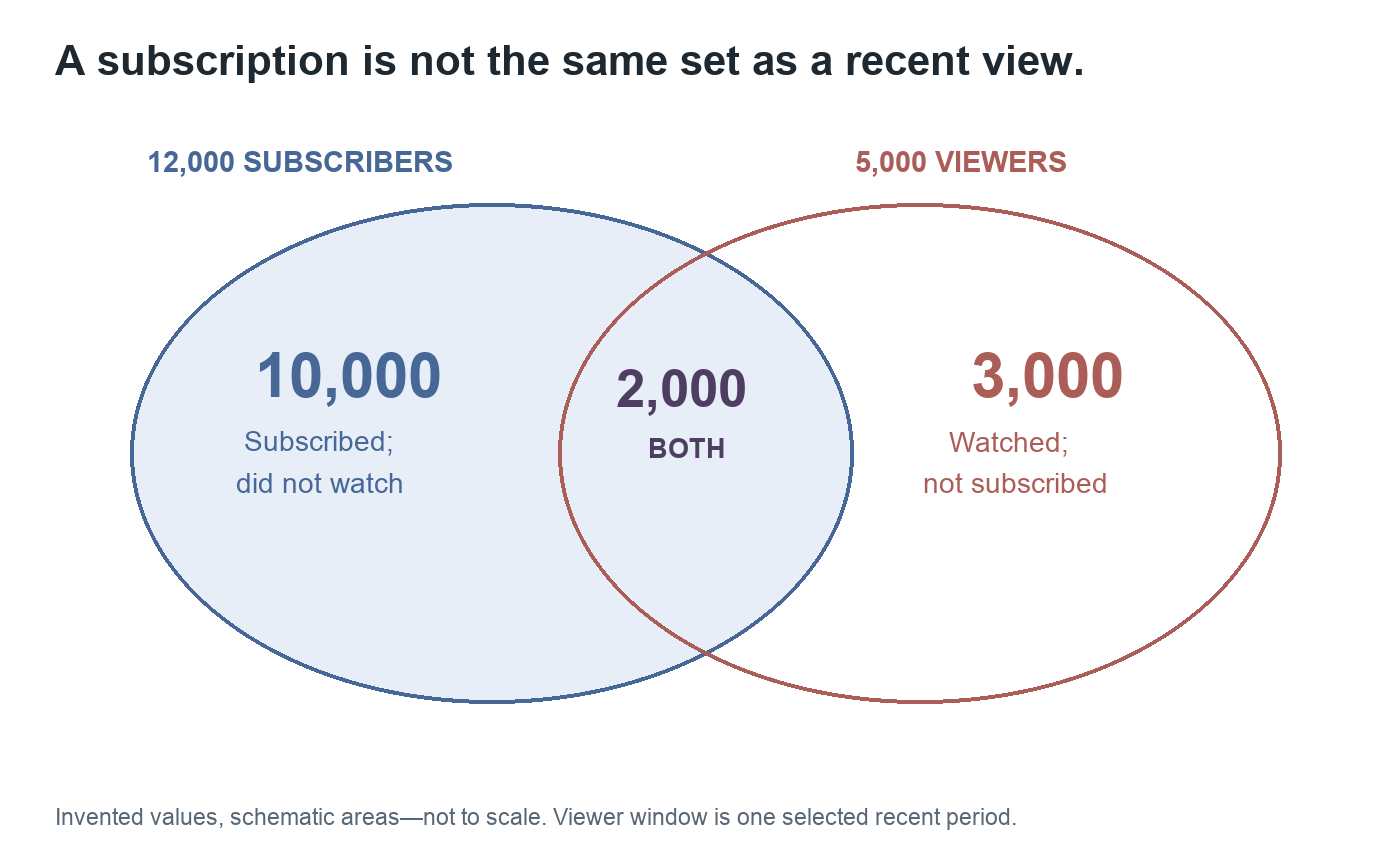
Hypothetical set illustration, not to scale: 10,000 subscribers did not watch in this period; 3,000 viewers were not subscribers. The overlap is 2,000 people.
The overlap visual makes the missing information visible. Total subscribers and total viewers do not tell you how many people are in both groups. You need appropriate audience data to investigate subscriber viewing.
Avoid drawing elaborate conclusions about a competitor from public totals alone. An old searchable archive, a recent niche change, or a different upload schedule can alter the picture substantially.
Read the audience information as a sequence of questions
You do not need every available metric on one screen. Start with the decision you are trying to make, then find evidence relevant to it.
For Channel A, the immediate question might be whether the new subject is establishing an audience. For Channel B, it might be whether the beginner series gives people a reason to progress to the next lesson. Those questions lead to different comparisons.
How many people are watching now?
Use the recent audience estimate with a consistent time window. YouTube defines monthly audience using the preceding 28 days. YouTube's audience metrics reference.
Do not silently compare one channel's lifetime views with another's monthly viewers. Keep the metric name and date range beside the value in your notes.
Seasonality may matter. A channel about exam preparation or annual gardening tasks can have a useful audience that comes and goes with the need. A quieter month deserves context before a diagnosis.
Which videos are responsible for that reach?
Separate a one-off hit from a series that repeatedly attracts interest. Either can be valuable, but they imply different next steps.
If Channel A's recent reach mostly comes from an old tutorial, publishing more unrelated interviews may not serve those viewers. If Channel B's audience is spread across connected lessons, improving the sequence may be worth investigating.
This is where the content itself returns to the analysis. A spreadsheet cannot tell you whether the promise of lesson two follows naturally from lesson one unless you examine both.
What happens during the viewing experience?
Inspect retention and viewing duration in the context of what the video is doing. A dip after a complete answer means something different from a dip before the promised demonstration begins.
Watch the moment in question. Is the explanation confusing? Did you switch topics? Does the viewer need information you have not provided? Could they simply be finished?
Choose one concrete revision for the next script. “Show the comparison before discussing the equipment history” is an actionable decision. “Improve retention” is only an objective.
Does interest continue beyond one upload?
Look for repeated viewing over time, while allowing long-term categories time to develop. A new audience cannot instantly become a longstanding one.
You can also inspect less formal evidence: recurring questions, requests that build on previous lessons, and comments showing that people understand the series. Treat these as qualitative clues rather than a substitute for representative audience data.
The goal is to connect the numbers to a plausible account of what viewers are doing. Where the evidence is incomplete, leave the question open.
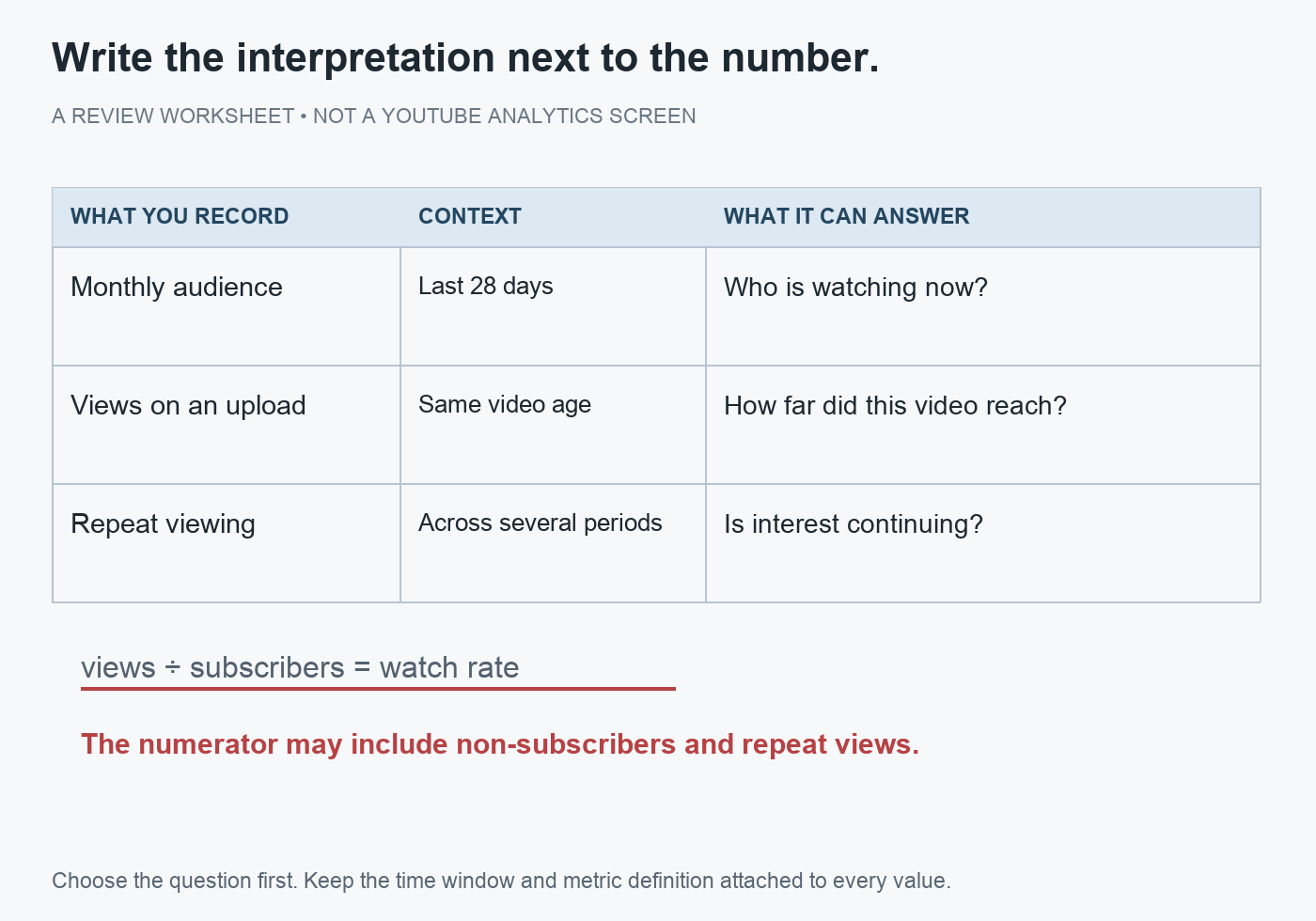
This is a planning worksheet, not a YouTube Analytics screenshot. Its annotations show how to move from a number to a decision.
Shorts can grow subscriptions without defining the whole channel
Imagine Channel B posts a funny Short about beginner mistakes. It attracts subscribers who enjoy the joke. The next upload is a detailed twenty-minute lesson.
Some people may want both. Others may prefer only the short-form experience. Shared subject matter does not make the viewing commitment identical.
Before judging those subscribers as “low quality,” examine what the Short led them to expect. Did it demonstrate the practical teaching style of the longer lessons, or promise a comedy series you do not intend to continue?
You can make the connection clearer by giving the formats complementary jobs. A Short demonstrates one useful distinction; the longer lesson explains how to apply it. You can also choose to build a short-form series on its own merits.
What matters is whether the growth supports the work you plan to keep making. A larger total can conceal a mismatch if most new interest comes from a direction you have already decided to abandon.
Subscribers still have practical value
There is no need to pretend the count is meaningless. Subscriptions help viewers express continuing interest, and subscriber requirements remain part of YouTube Partner Program eligibility alongside other conditions. Check Studio's Earn area for the requirements applicable to you. Partner Program overview.
Reaching a milestone can also be personally motivating. A first hundred subscribers may represent months of learning. Celebrating that does not require claiming it predicts your next video's reach.
The useful distinction is between celebration and diagnosis. “More people chose to subscribe” is good news. “Our new format is building an active audience” requires additional evidence.
Keep asking for subscriptions when the invitation fits. Explain the future value: “I test practical audio fixes for small rooms” tells people more than “Help me reach the next milestone.” The request should describe a benefit you intend to deliver.
Do not let the request interrupt the promised answer so early that viewers have no basis for deciding. Show them what the channel offers, then make the invitation specific.
A better review for Channel A
Channel A does not need to start by deleting inactive subscribers or apologizing for its public ratio. It needs to understand the relationship between its archive, current direction, and recent audience.
The creator could group recent uploads by subject and compare similar viewing windows. Which topics still attract the intended viewers? Which new ideas have a plausible continuation? Which successful older videos lead to an experience the channel no longer offers?
Growwly's free Channel Audit can help surface public catalogue patterns for that initial review. The creator should then use their private Studio data to investigate the audience behind those patterns.
A reasonable next experiment might be a small series that connects an established problem to the new direction. Another could be a cleaner separation of unrelated content. The right answer depends on evidence and what the creator wants to produce, not on protecting the largest-looking number.
What Channel B should avoid
Channel B's stronger recent reach does not give it permission to ignore subscriptions or assume its current format will keep working. It still needs to understand why people watch and whether the production process is sustainable.
The creator could examine which lessons make the series' continuing value clear. If a particular upload attracts more subscriptions, inspect the promise and audience rather than copying its title mechanically.
A useful next objective might be making lesson two easier to discover after lesson one. That is a specific improvement the creator can make even if the subscriber counter grows slowly for a while.
Both channels benefit from the same discipline: name the question before selecting the metric. The subscriber total remains part of the picture. It becomes less misleading when you stop asking it to explain the whole channel.

The Psychology Behind Videos That Get Millions of Views
Explore the psychology of viral videos, from curiosity and emotion to clarity and payoff, with evidence-led ideas for YouTube Shorts and long-form content.
Read the post
Why Going Viral Can Kill Your Channel and How to Avoid It
Can going viral hurt your YouTube channel? Explore the risks of chasing a hit, losing focus, overspending and how to protect your creative direction.
Read the post