Should You Delete Underperforming YouTube Videos?
Should you delete underperforming YouTube videos? Learn when to keep, improve, unlist, or remove an upload—and what to check before making that decision.
The video you want to delete may be doing exactly what it was made to do. It might answer a small question for a small audience. It might also be genuinely misleading, outdated, or a poor introduction to your current work. A low view count does not tell you which situation you are in.
Do not delete an underperforming YouTube video just to clean up your numbers. First decide whether you have a performance problem, a publishing problem, or a piece of content that should no longer be available. Those call for different actions.
Here are four situations that make the distinction practical. The channels and examples are hypothetical, but the publishing options follow YouTube's documentation.
Situation 1: the useful tutorial nobody seems to notice
You publish a seven-minute tutorial about reducing echo in a small room. It receives fewer views than your recent microphone review. You start wondering whether the tutorial makes your channel look unsuccessful.
Before touching the delete button, revisit the purpose. The microphone review serves people considering a purchase; the echo tutorial serves people trying to solve a recording problem. Those audiences may differ in size and urgency. Equal production effort does not imply equal demand.
Now examine the invitation. Suppose the title is “My Recording Setup Update,” and the thumbnail shows a wide shot of your desk. A stranger has little reason to infer that the video solves their echo problem.
A clearer title might be “Reduce Room Echo Without Buying a New Microphone.” That is appropriate only if the video demonstrates changes that can do that. The thumbnail could show the specific room change rather than the whole desk.
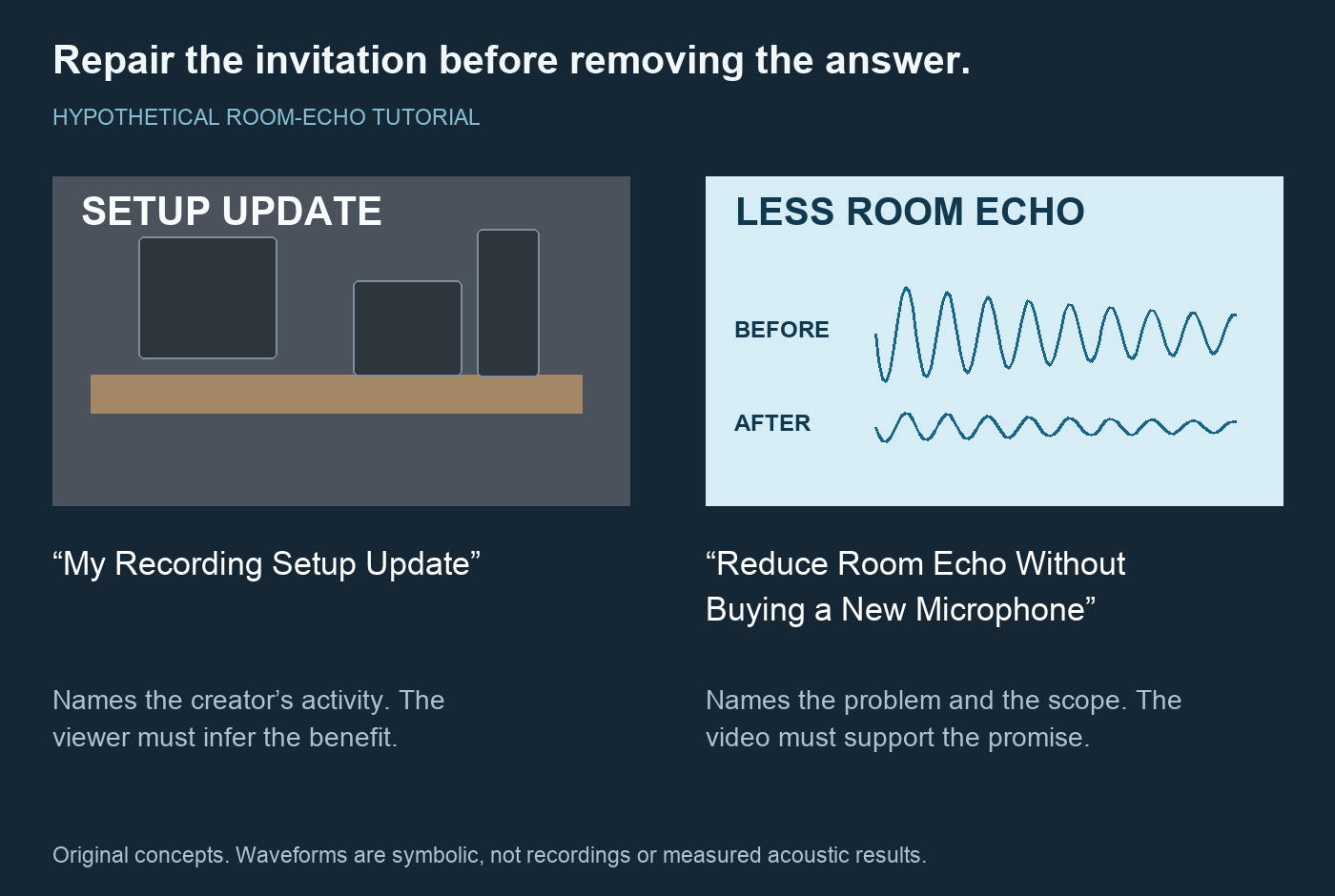
Illustrative redesign, not a measured test. The improvement is a clearer promise; a higher click-through rate is not guaranteed.
This is a packaging problem worth investigating. Deleting the video would remove the useful answer along with the unclear invitation.
Record the original title, thumbnail, and date before changing them. Choose a review window appropriate to your normal traffic. If the response changes, remember that audience and traffic sources may have changed too. A before-and-after comparison can guide your next decision without proving the new design caused every additional view.
Where available for an eligible upload, YouTube's thumbnail testing offers a more structured comparison using watch time share. How thumbnail testing works.
Situation 2: people click, then discover a different video
Your title promises a practical fix. The opening begins with a minute about why you bought your camera, another section about your channel, and a montage of the recording setup. The useful demonstration starts much later.
Here the thumbnail may be doing its job: it attracts people who want the fix. The opening makes those people wait through material they did not choose.
Watch the first section without defending it. Which sentences help a new viewer understand the problem? Which explain your personal history? Which repeat the title without adding evidence?
A tighter opening might be:
“This is the same microphone in the same room. Listen to the reflection after each clap. Moving the desk and adding this soft surface changed the recording; I'll show you the setup.”
That opening establishes a comparison and begins the promised work. It still needs an honest explanation of what changed and what other factors matter.
You may be able to trim an unnecessary section. You may decide that the better lesson belongs in the next upload. Neither decision requires treating the original as a stain on the channel.
YouTube says its systems rely more on video- and audience-level responses than on a single upload's poor performance. One disappointing result is not an instruction to erase it. YouTube's performance FAQ.
For Shorts, use the same reasoning at a smaller scale. Does the first frame establish the situation? Can someone follow the demonstration without replaying it just to understand what happened? Reposting an unchanged Short does not answer those questions.
Situation 3: the video is accurate, but you no longer want public discovery
Perhaps you made a tutorial for an old workshop. Participants still use the link, but the video no longer belongs in your public catalogue. Or you have changed the channel's direction and want an early experiment available only to people who already have it.
This is a distribution decision. The distinction between unlisted and private matters more than the view count.
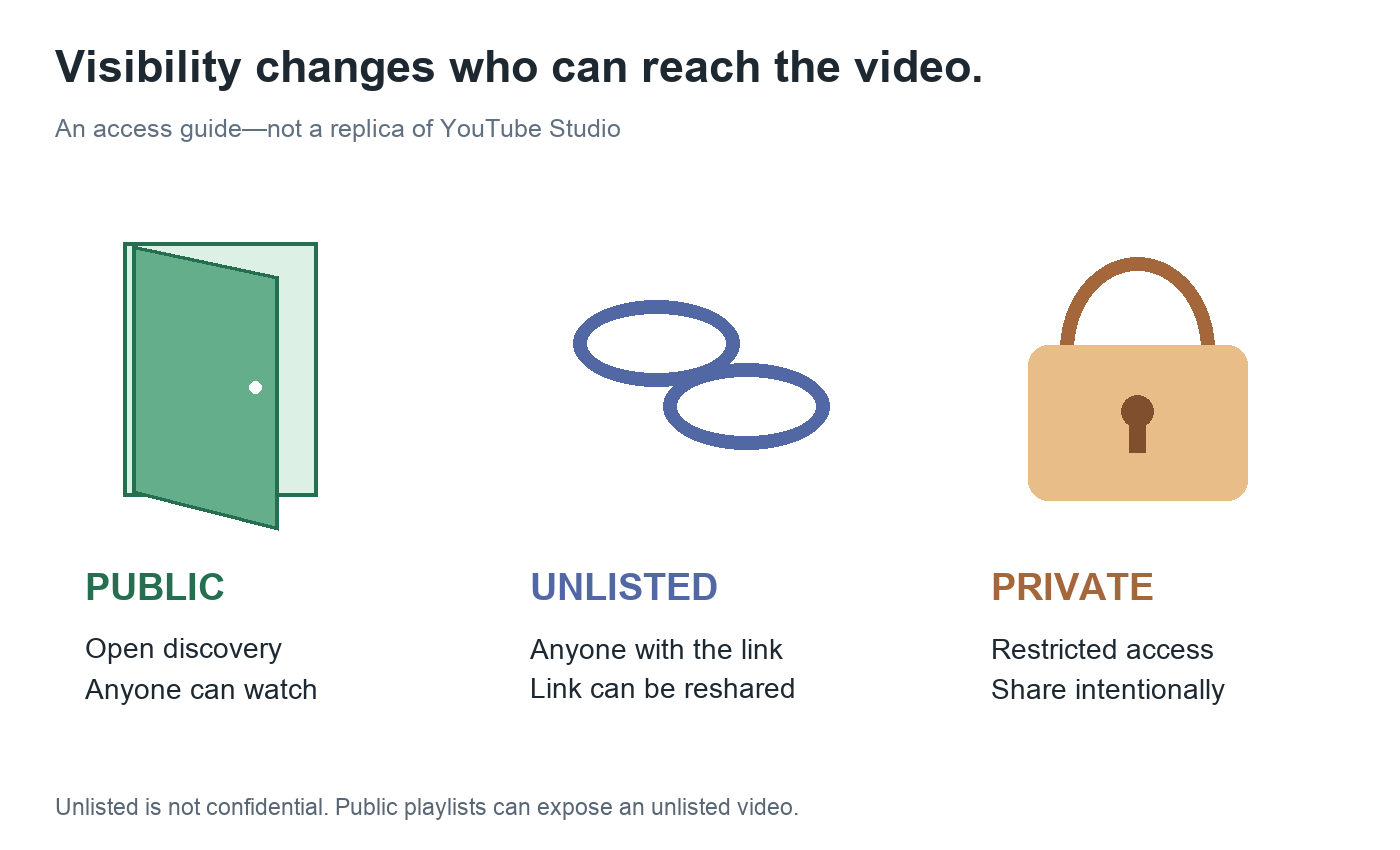
Original explanation of access choices, not a screenshot of YouTube Studio. Anyone with an unlisted link can reshare it.
An unlisted upload remains available by link. Private access is restricted. YouTube also notes that an unlisted video can appear through a public playlist, so unlisted should not be treated as confidential. YouTube's visibility documentation.
Before changing visibility, check where the video is used. A workshop handout, embedded lesson, or older blog post may still send people to it. Making it private without updating those references can create a frustrating experience for the very audience it serves.
For a routine change in Studio, open Content, find the upload, and use its Visibility setting. Choose the option that matches the access you intend, then save. Read the on-screen description before confirming, especially if a link is already in circulation.
You can make a deliberate editorial decision to reduce public exposure. You do not need to claim that doing so resets the recommendation system.
Situation 4: the content should actually come down
Now imagine the echo tutorial contains an important error that could mislead viewers, or a background shot reveals personal information. Perhaps you uploaded the wrong file, lack rights to distribute material in it, or cannot make an adequate correction within the existing video.
Those are substantive reasons to reconsider publication. The fact that the upload has only a few hundred views does not make the problem less important; a popular upload could warrant the same decision.
Ask whether editing can fully solve the issue. A small correction in a description will not necessarily reach someone who watches only the video. If the core explanation is wrong, a corrected upload may be more appropriate than a note hidden below it.
Before permanent deletion, keep the source file if you need it, save useful production notes, and check inbound links. YouTube states that deletion is permanent and a new upload gets a new URL. A replacement will not simply inherit the old address. YouTube's deletion guidance.
You do not need to preserve harmful or inaccurate material for the sake of its statistics. Equally, normal embarrassment about an early editing style is not the same as a content error. Be clear about which concern you are addressing.
Choose the action with a short decision tree
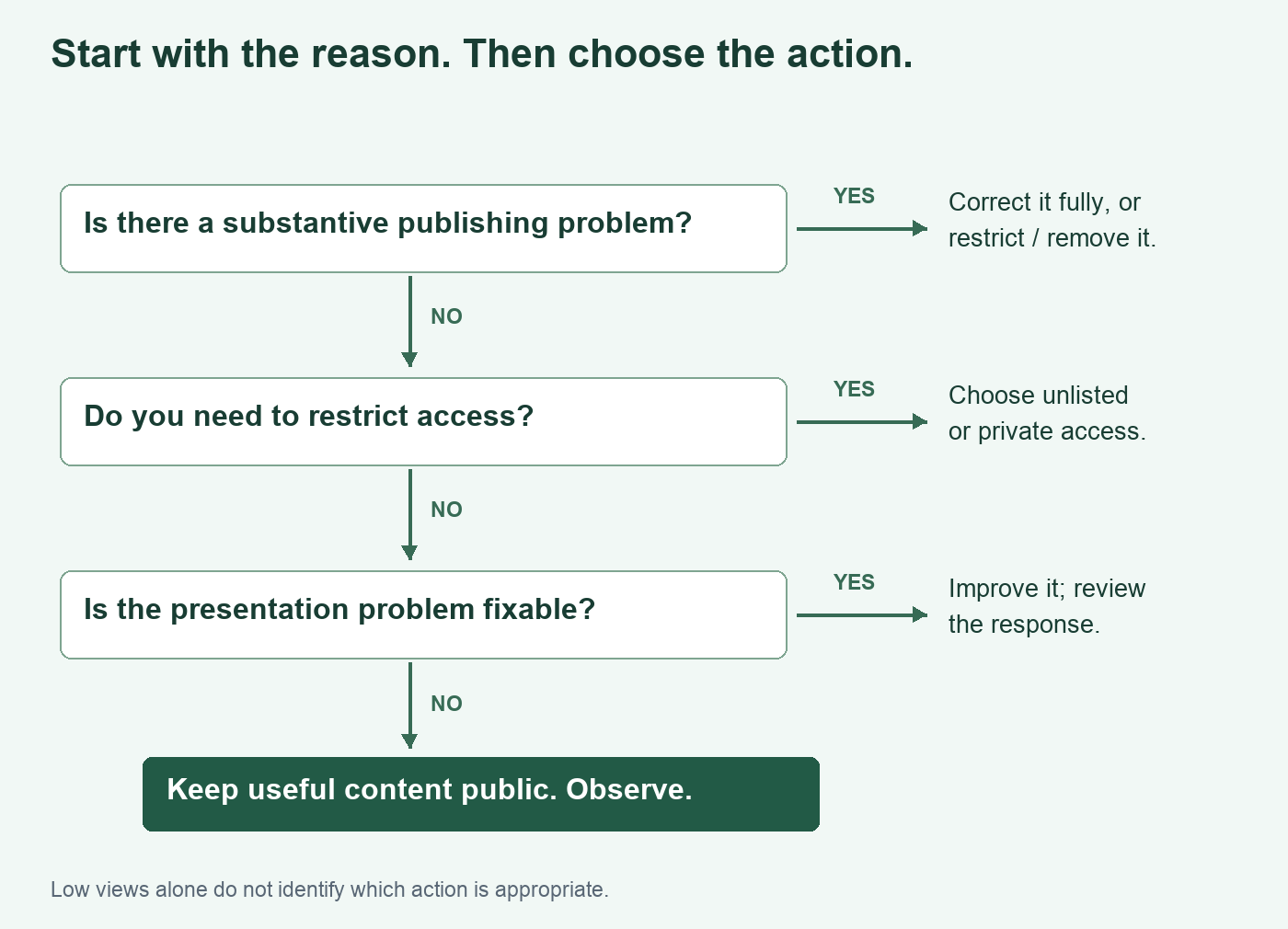
Work from the reason to the action. “Below my usual views” is a reason to investigate, not the final decision.
The tree deliberately starts with content suitability rather than performance. If publication itself is the problem, more impressions are not the solution. If the content is useful and accurate, you can move on to how it is presented and discovered.
There is no universal waiting period that makes a video safe to judge. A time-sensitive update and an evergreen tutorial have different useful lives. A small channel may need longer to collect meaningful evidence than a large one.
Use comparable upload ages and formats when you evaluate performance. Comparing a new Short with an old documentary's lifetime total tells you very little. Write the comparison window next to your numbers so you do not quietly change the standard when a result disappoints you.
Check eligibility before a large cleanup
If you are working toward YouTube Partner Program eligibility, review the Earn area of Studio before changing many uploads. Private, unlisted, and deleted videos do not contribute to the relevant public-viewing eligibility totals under YouTube's rules. Partner Program requirements.
This is a practical consequence to understand, not a reason to keep unsuitable content public. It matters most when someone plans to remove an entire early catalogue simply because the videos look less polished than their newer work.
Make a list first. For each upload, write the intended action and a reason that does not depend on its view count alone. “Outdated setup instructions; replace with a current guide” is useful. “Looks bad beside the successful one” needs more thought.
A small review also makes it easier to catch links you would otherwise break. If a video sits at the start of a playlist, changing it may affect how newcomers understand the rest of the series.
When a remake earns its place
A remake should have a clear creative brief. For the room-echo tutorial, that might be: show the sound comparison first, explain the room layout with a diagram, and remove the unrelated camera discussion.
That is a different proposition from “upload the same file again and hope.” You are changing what the viewer receives.
Decide what to do with the original separately. If it remains accurate and useful, it may stay public with a relevant link to the update. If it is misleading, restrict or remove it for that reason. If people need it for an older version of a workflow, preserve access in a way that makes the distinction clear.
For a Short, a meaningful remake could clarify the first shot or slow an essential demonstration. Faster is not always clearer. If people need to see a hand position or read a label, cutting the explanation further may make the same problem worse.
Keep your production notes. They let you compare what changed instead of relying on memory after the new upload produces an emotionally satisfying—or disappointing—result.
Leave yourself a decision record
Before making a change, write four short lines: what the video is for, what evidence concerns you, what you plan to change, and what would make the decision worth revisiting.
For example: “This teaches beginners to reduce room echo. The title currently hides that benefit. I will make the promise specific and keep the content public. I will review comparable traffic and viewer response after it has had a meaningful chance to be seen.”
That record is useful even if the video never becomes a hit. It keeps your action tied to the problem you identified.
Sometimes the right answer is to delete. Often it is to improve, reorganize, or leave a useful upload alone. The quality of the decision comes from knowing why you made it.

The Psychology Behind Videos That Get Millions of Views
Explore the psychology of viral videos, from curiosity and emotion to clarity and payoff, with evidence-led ideas for YouTube Shorts and long-form content.
Read the post
Why Going Viral Can Kill Your Channel and How to Avoid It
Can going viral hurt your YouTube channel? Explore the risks of chasing a hit, losing focus, overspending and how to protect your creative direction.
Read the post