How Much Money Does YouTube Really Pay?
Discover how much YouTube pays per 1,000 views in 2026. Compare RPM vs CPM, long-form vs Shorts earnings, and top-paying niches with updated data.

Every day, thousands of new creators upload their first video, dreaming of turning their passion into a full-time career. But behind the glitz and glamour, a pressing question remains: how much money does YouTube actually pay?
If you are looking for a simple, flat rate, you won't find one. YouTube does not pay a fixed salary or a guaranteed rate per view. Instead, your income is tied to a complex web of factors including your specific content niche, the geographic location of your audience, your video format (Shorts vs. Long-form), and viewer engagement metrics.
In 2026, the creator economy has matured, and the data on what advertisers are willing to pay is clearer than ever. Whether you are trying to calculate the earning potential of your next big project or just curious about how the business works, this comprehensive guide breaks down exactly what you can expect to earn on YouTube today.
The Core Metrics: CPM vs. RPM
Before we talk dollars and cents, you must understand the difference between the two most important acronyms in the YouTube Partner Program. Misunderstanding these two metrics is the number one reason new creators miscalculate their potential earnings.
- CPM (Cost Per Mille): This represents the amount of money advertisers pay YouTube for every 1,000 ad impressions served on your videos. It is a metric of advertiser demand, not your take-home pay.
- RPM (Revenue Per Mille): This is what you actually earn per 1,000 views after YouTube takes its cut. For traditional long-form videos, YouTube takes 45% of the ad revenue generated on your watch pages, leaving you with 55%. Your RPM also factors in views where no ads were shown (which lowers the average), as well as supplementary income from channel memberships, Super Chats, and YouTube Premium viewers.
When projecting your channel's income, RPM is the only metric that matters.
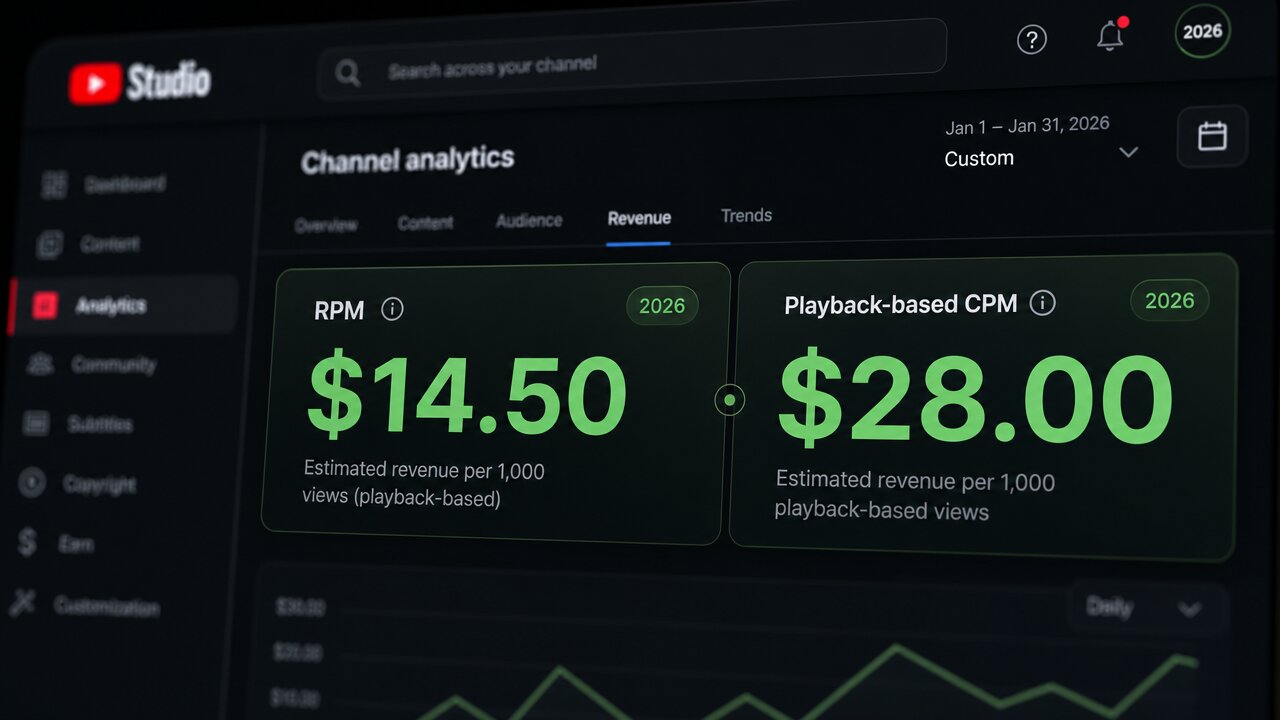 Understanding the key metrics in YouTube Studio — CPM vs. RPM.
How Much Does YouTube Pay Per 1,000 Views in 2026?
The median RPM across all YouTube niches in 2026 sits at approximately $2.30 per 1,000 views. However, this average hides massive variations.
Depending on what your channel is about and who is watching it, your RPM could realistically be as low as $0.33 or as high as $40.00.
Why is there such a massive gap? Advertising is a bidding war. Advertisers are willing to pay a heavy premium to reach audiences that have high purchasing power and are close to making a buying decision. For example, software companies and insurance firms will outbid each other aggressively to place an ad in front of a viewer watching a video about "Best Accounting Software for Small Businesses." Conversely, they will pay far less to advertise on a general gaming let's-play or a comedy skit, where the audience intent is purely entertainment.
The 1 Million Views Benchmark: Long-Form vs. Shorts
Hitting 1 million views is a major milestone for any creator. Here is what that traffic translates to in real dollars in 2026.
Long-Form Videos (8+ Minutes)
For traditional, horizontal videos, you have multiple opportunities to show ads, including pre-roll, mid-roll, and post-roll placements. Because viewers spend more time watching, advertisers pay more.
- Average Earnings: For most lifestyle, vlog, and entertainment channels, 1 million views yields between $2,000 and $5,000.
- High-Paying Niches: If you create content in finance, business, or tech, that same 1 million views can yield between $15,000 and $40,000.
- Low-Paying Niches: Channels focused on gaming, memes, or kids' content generally earn between $500 and $2,000 per million views.
YouTube Shorts
YouTube Shorts operate on a completely different revenue-sharing model. Because Shorts are swiped through so rapidly, ads are shown between videos in the feed, not on the videos themselves. The ad revenue is pooled together and distributed to creators based on their proportional share of total Shorts views.
- Average Earnings: Creators typically earn between $50 and $200 per 1 million Shorts views.
- The RPM Reality: The RPM for Shorts is incredibly low—averaging between $0.05 and $0.30 in Tier 1 countries like the US, and dropping to as low as $0.01 in developing markets.
While Shorts pay a fraction of what long-form content does, they remain unparalleled for rapid audience growth and subscriber acquisition. The most successful channels use Shorts as a discovery engine to funnel viewers toward their highly monetized long-form videos.
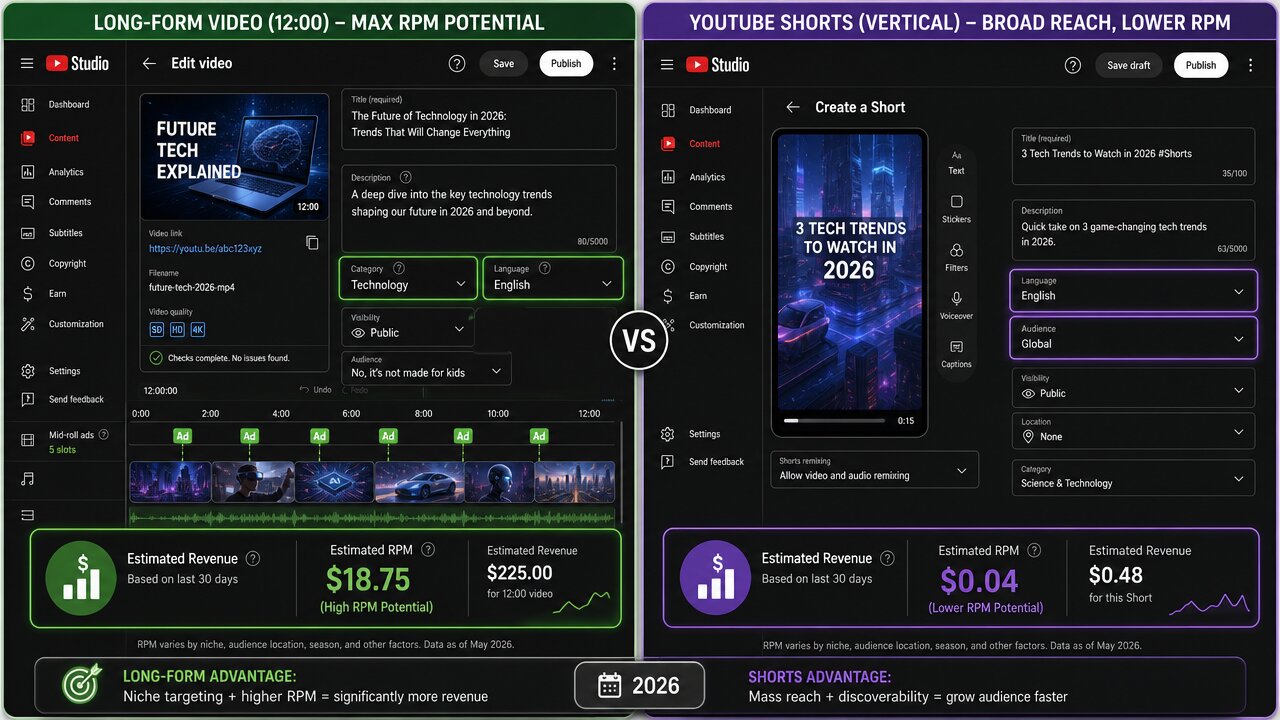 Workflow and monetization structural comparison between Long-Form videos and YouTube Shorts.
The Highest Paying YouTube Niches in 2026
Your content category dictates your earnings ceiling. If you are starting a channel purely for revenue generation, choosing the right niche is critical. Here is a breakdown of estimated RPM ranges for US audiences by popular niches:
| Content Niche | Estimated RPM Range (2026) | Earning Potential (per 1M views) |
|---|---|---|
| Finance, Investing & Insurance | $12.00 – $40.00 | $12,000 – $40,000 |
| Technology & Software | $5.00 – $15.00 | $5,000 – $15,000 |
| Education & Science | $4.00 – $10.00 | $4,000 – $10,000 |
| Lifestyle & Vlogs | $3.00 – $6.00 | $3,000 – $6,000 |
| Gaming & Entertainment | $1.00 – $4.00 | $1,000 – $4,000 |
Key insight: Niche sets the floor, but execution sets the ceiling. Even within "Education," the lowest-earning channels make $2.31 per 1,000 views while top performers in the same category pull in nearly $20.00.
Audience Geography: The Hidden Revenue Multiplier
A million views from the United States do not pay the same as a million views from India. Advertiser budgets are highly localized based on the economic strength and purchasing power of the target region.
- Tier 1 Countries (Highest CPMs): The United States leads the pack with an average advertiser CPM of $14.67. Other high-paying regions include Australia ($13.30), Switzerland ($12.98), the UK ($8.91), and Canada ($9.93).
- Tier 2 & 3 Countries (Lower CPMs): Developing markets have significantly lower ad rates. India, despite having the largest YouTube user base globally, has an average CPM of $0.74 (resulting in an RPM between $0.60 and $2.40 depending on the niche). Other regions like Pakistan, Egypt, and the Philippines see similar rates ranging from $0.50 to $1.50.
What this means for you: If you run a tech channel targeting viewers in India, your RPM might hover around $1.00, earning you roughly $1,000 per million views. If you create the exact same tech content but target an American audience, your RPM could jump to $10.00, instantly 10x-ing your revenue to $10,000 for the exact same view count.
2026 YouTube Partner Program Requirements
Before you can earn a single cent from ad revenue, you must qualify for the YouTube Partner Program. In 2026, YouTube maintains a highly accessible two-tiered system that allows smaller channels to start earning early.
Tier 1: Fan Funding & Early Access
This tier allows you to monetize your dedicated audience before you hit scale. It unlocks Channel Memberships, Super Chats, Super Stickers, and YouTube Shopping. To qualify, you need:
- 500 subscribers
- 3 public uploads in the last 90 days
- AND either: 3,000 valid public watch hours in the past 12 months OR 3 million valid public Shorts views in the past 90 days.
Tier 2: Full Ad Revenue
This is the threshold required to get a cut of the ad revenue generated on your videos. To unlock AdSense revenue sharing, you need:
- 1,000 subscribers
- AND either: 4,000 valid public watch hours in the past 12 months OR 10 million valid public Shorts views in the past 90 days.
Note: For both tiers, you must adhere strictly to YouTube's monetization policies, have no active community guideline strikes, and have 2-Step Verification enabled on your Google account.
How to Increase Your YouTube RPM in 2026
Even if you are currently in a lower-paying niche or targeting a lower-CPM geographic region, there are concrete, actionable steps you can take to squeeze more revenue out of the views you already have:
- Extend Your Video Length: Videos that are over 8 minutes long are eligible for manual mid-roll ads. Strategically placing 2 to 3 mid-roll ads in a highly engaging 12-minute video can instantly double your overall RPM compared to relying solely on the default pre-roll ads.
- Optimize for Audience Retention: Advertisers only pay if their ads are actually seen. If your viewers consistently click away after 45 seconds, they will never see your mid-roll ads. High retention rates signal to the YouTube algorithm that your content is high quality, which in turn attracts premium, higher-paying advertisers.
- Target High-Value Keywords: Even within a general niche like "Lifestyle," you can pivot your content strategy to attract better advertisers. Targeting specific, buyer-intent search terms (like "Best Budget Laptops for College 2026") will attract tech advertisers who pay significantly higher rates than those advertising on a general "My Morning Routine" vlog.
- Localize for High-CPM Markets: If your RPM is low purely due to geography, consider adding professional English captions, localized titles, or even secondary dubbed audio tracks to your videos. This makes your content accessible and attractive to viewers in Tier 1 countries like the US, UK, and Australia, allowing you to tap into those premium ad budgets.
The Bottom Line
If your goal is to make a full-time living on YouTube in 2026, relying solely on AdSense ad revenue is a dangerous game. Ad rates fluctuate wildly based on seasonality (Q4 is always the highest paying, while Q1 drops significantly) and broader economic conditions.
The most successful creators treat their YouTube channel as a top-of-funnel marketing engine. They use AdSense as a baseline income, but multiply their earnings by funneling their audience toward lucrative brand sponsorships, high-ticket affiliate marketing, branded merchandise, and proprietary digital products. By understanding how the math of YouTube works, you can stop guessing and start treating your channel like the scalable business it is.

Why Kurzgesagt Gets So Many Returning Viewers
Kurzgesagt uploads just twice a month yet keeps 25.4M subscribers coming back for more. Here's the exact retention system behind it, backed by data — and how any creator can borrow it.
Read the post
The Ultimate YouTube Publishing Checklist
Want your videos to rank higher? Discover the ultimate YouTube publishing checklist. Learn the exact SEO and upload steps to guarantee your content gets seen.
Read the post