Why Kurzgesagt Gets So Many Returning Viewers
Kurzgesagt uploads just twice a month yet keeps 25.4M subscribers coming back for more. Here's the exact retention system behind it, backed by data — and how any creator can borrow it.

Most creators chase a new viewer. Kurzgesagt built an entire business model around getting the same viewer to come back, again and again, for over a decade — on a schedule most YouTube strategists would call reckless.
Consider the math. According to Growwly's channel audit of @kurzgesagt, the channel uploads roughly 0.4 videos per week — about twice a month — and still commands 25.4 million subscribers and 3.8 billion lifetime views. For comparison, most creators are told that consistency means daily Shorts and at least one long-form video a week, or the algorithm forgets you exist. Kurzgesagt seems to have skipped that memo entirely, and it's still one of the most reliably watched education channels on the platform.
That's not an accident, and it's not really about virality either. It's about returning viewers — the unglamorous metric that quietly powers every channel that lasts longer than a trend cycle. Kurzgesagt has engineered nearly every part of its production, from thumbnail color palette to sentence structure, around getting a subscriber to open the next video without thinking twice.
We pulled the channel's public data through our Channel Audit tool and cross-referenced it with Kurzgesagt's own public statements about how they work. Here's what's actually driving the repeat visits — and what any creator, in any niche, can take from it.
The Metric Most Creators Ignore: Returning vs. New Viewers
New-viewer growth gets all the attention because it's visible — a video pops off, subscribers spike, screenshots get shared in Discord servers. But a channel that only wins new viewers and never gets them to come back is running on a treadmill: every upload has to work as hard as the last one, forever.
Returning viewers are different. They don't need to be convinced by your thumbnail — they've already decided to trust you before they see it. That trust is a compounding asset, and it's the reason Kurzgesagt can post half as often as a typical mid-size channel and still show up in millions of feeds the moment a new video drops.
The audit's numbers make the shape of this clear:
- 25.4M subscribers, built on 200 recent videos analyzed over a roughly nine-year window
- 3.8B total views, growing steadily rather than in occasional viral spikes
- 0.4 uploads per week, with 98% on-schedule adherence — meaning when Kurzgesagt says a video is coming, it comes
That last stat is easy to skim past, but it's arguably the most important one on the page. A 98% on-schedule rate over hundreds of uploads means the channel has trained its audience to expect it — the same way people expect a magazine to hit their mailbox on the first of the month.
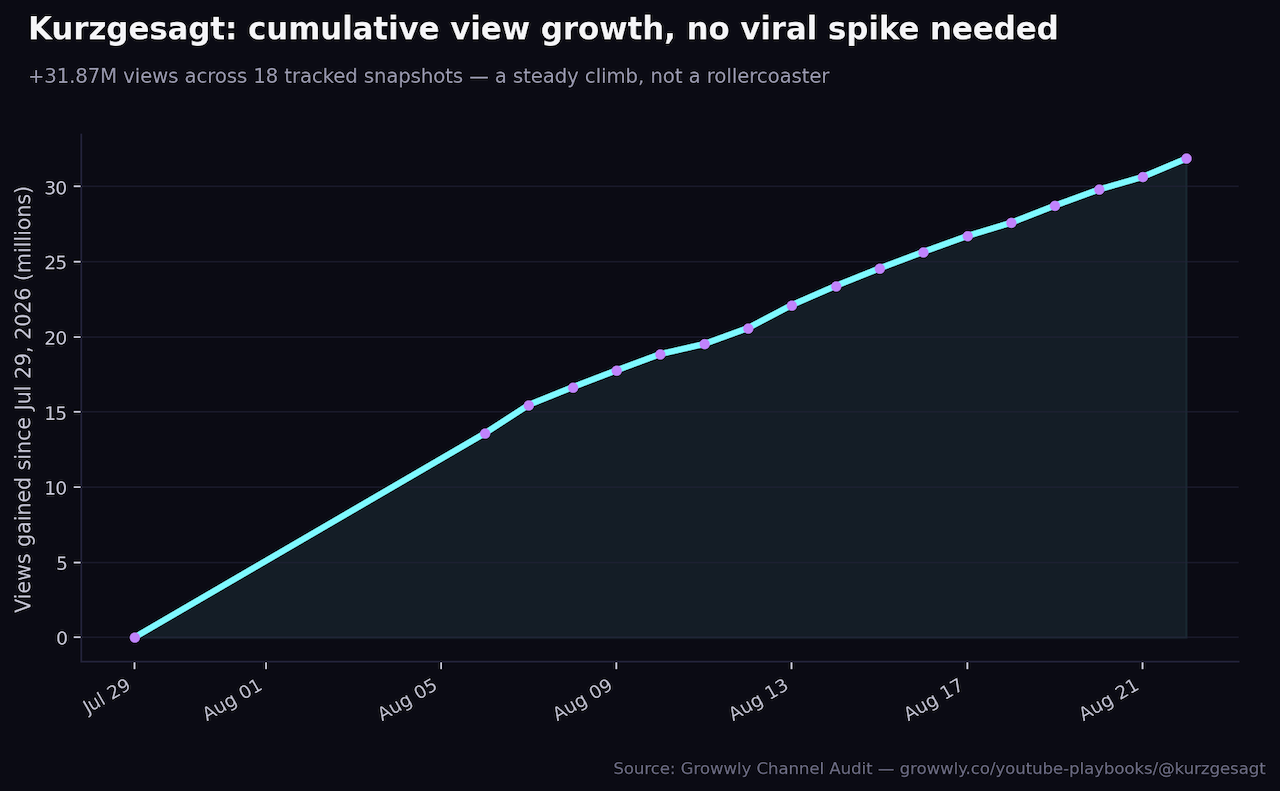
Notice the shape of that curve. There's no single spike dragging the average up — it's a near-straight line. That's what a returning-viewer base looks like on a graph: reliable, boring in the best way, and very hard to replicate with one lucky viral hit.
1. A Visual Uniform Viewers Recognize Before They Read the Title
Open any Kurzgesagt thumbnail and you'll see the same formula: a glowing, neon-lit object — a virus, a planet, a brain — floating on a dark purple-to-black background, paired with bold white all-caps sans-serif text. According to Growwly's vision-model read of the channel's thumbnails, there's no stock photography, no photoreal faces, no shocked-expression close-ups. Just the same illustrated house style, upload after upload.
This matters more than it looks like it should. A viewer scrolling their subscriptions feed doesn't read every title — they pattern-match on color and shape first. Kurzgesagt's neon-on-void palette functions like a uniform: it tells a returning viewer "this is one of ours" in a fraction of a second, before a single word registers. That recognition speed is a retention mechanic, not just a design choice.
If you're building a smaller channel, you don't need Kurzgesagt's animation budget to copy this. You need one consistent color story and one consistent typographic choice that shows up on every single thumbnail, regardless of topic. Consistency compounds; novelty in your packaging resets the recognition clock every time.
2. Titles That Sell a Feeling, Not Just a Topic
Kurzgesagt's titles are short, specific, and almost never neutral. Growwly's title-mechanics data on the channel shows that 28% of titles are phrased as questions, and the highest-performing keyword cluster includes words like "about," "planet," "over," "inside," "heard," and "brain" — all of them framing devices that promise either a revelation or a reframe of something the viewer thought they understood.
Four of the channel's measured breakout leaders, ranked by views-per-day against the channel's median, show the pattern clearly:
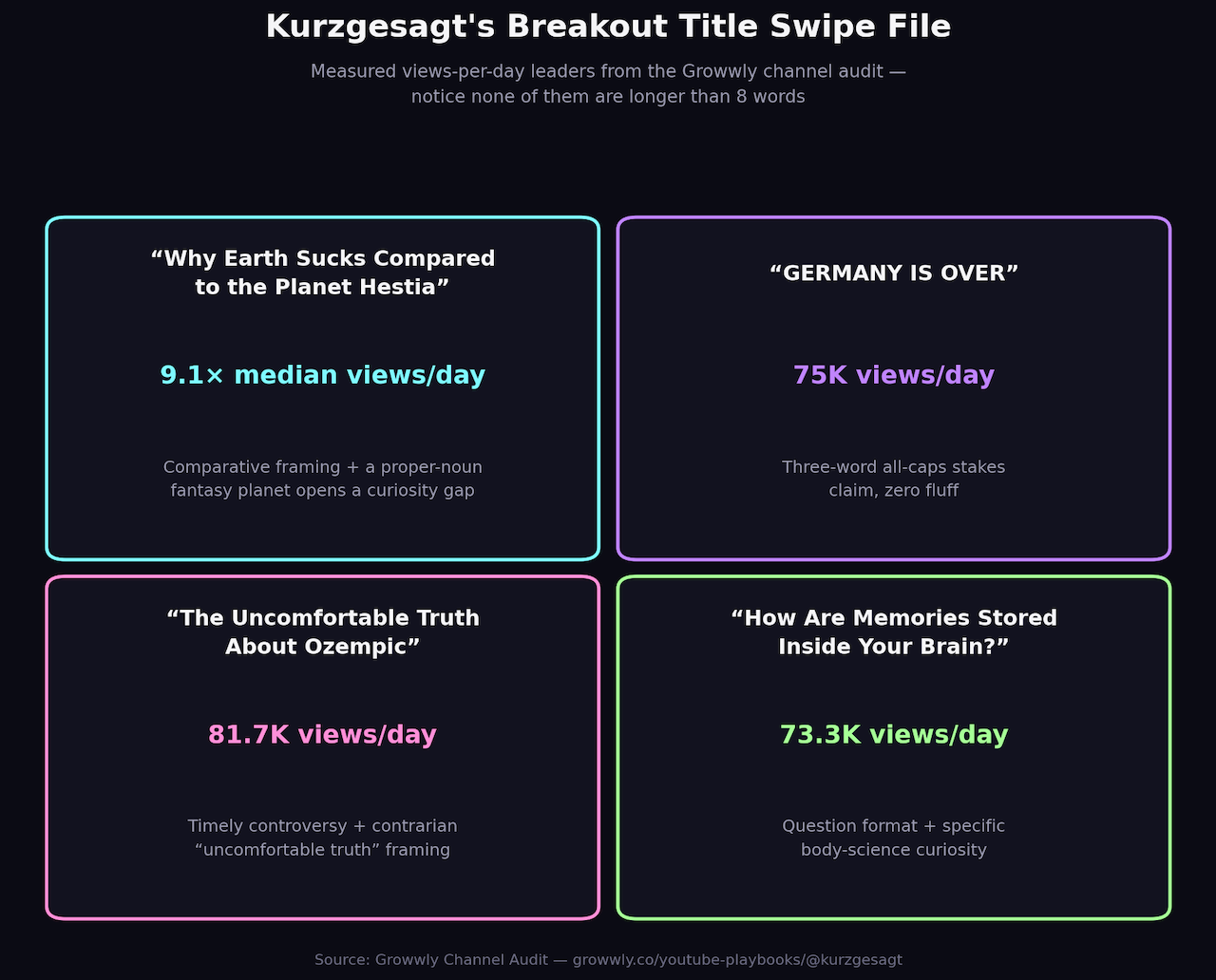
What's notable isn't just that these titles are catchy — it's that none of them are longer than eight words, and every single one pairs a specific noun ("Ozempic," "Hestia," "your brain") with a stake (a truth, a comparison, a threat). That combination is what separates a curiosity-gap title from a vague, clickbait one that burns trust on the second watch. A returning viewer has been burned by creators who over-promise in the title and under-deliver in the video; Kurzgesagt's specificity signals it won't do that again this time.
3. The Emotional Formula: Dread, Then Relief, on Repeat
This is the part of Kurzgesagt's playbook that's hardest to screenshot, because it's structural rather than visual. Nearly every video follows the same five-beat emotional arc, and once a viewer has experienced it a few times, they start coming back for the feeling of the arc as much as for the topic itself.
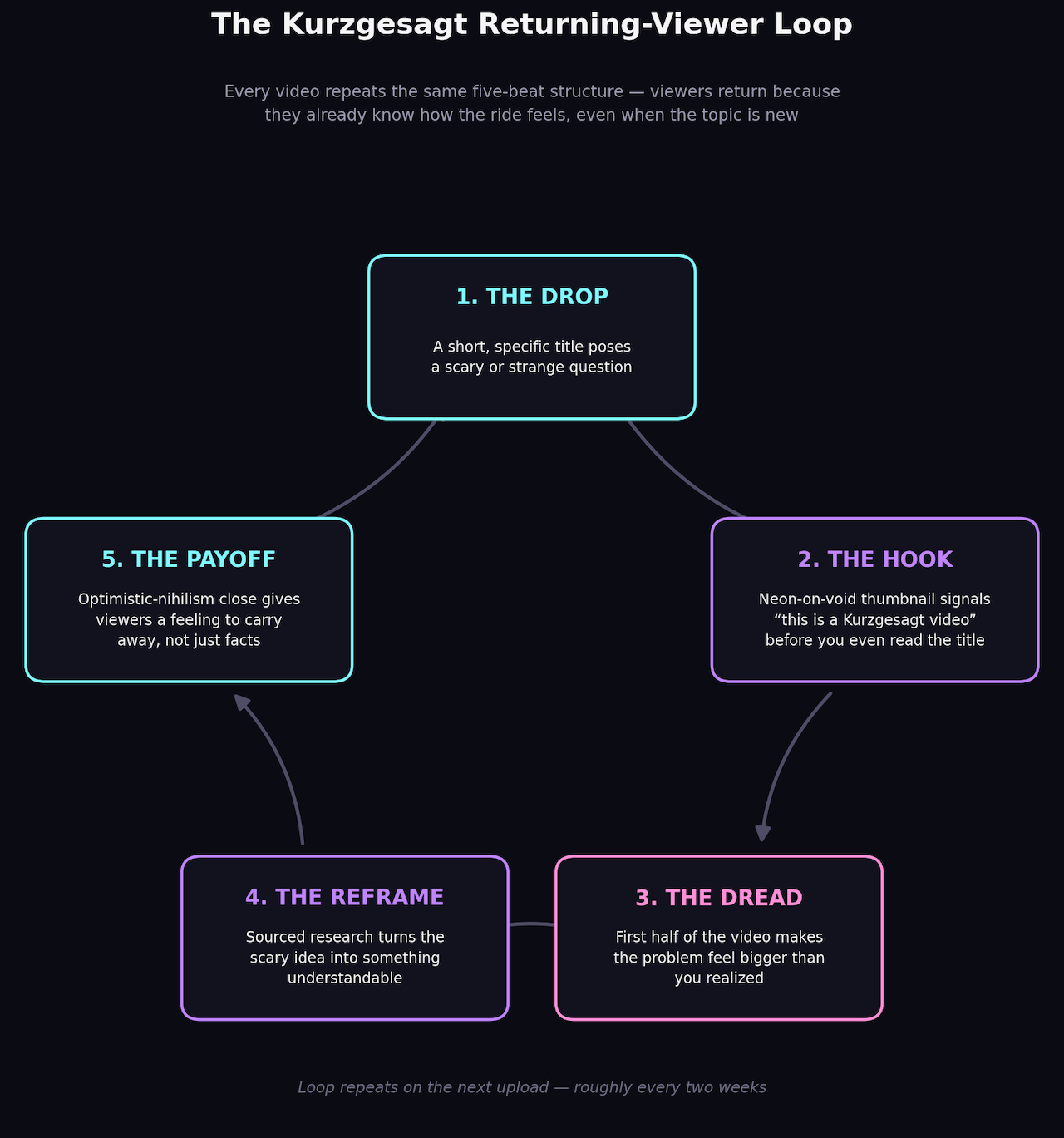
The channel's own public writing calls this philosophy "optimistic nihilism" — the idea that the universe is vast and indifferent, which is precisely what makes it freeing rather than depressing. A typical script opens by making a problem feel bigger and scarier than the viewer realized, then spends the second half using research and expert-reviewed explanation to shrink that fear back down into something understandable, often landing on a hopeful or humorous note.
That structure is emotionally identical from video to video even when the topic changes completely — memory storage one week, a hypothetical rogue planet the next. A returning viewer isn't just subscribing to a topic list; they're subscribing to a reliable emotional experience, the same way people return to a specific stand-up comedian's rhythm or a specific horror director's pacing, regardless of the plot.
If you make videos in a completely different niche, the topic-agnostic lesson is this: pick an emotional shape for your content and repeat it deliberately. It could be "skeptical, then convinced." It could be "chaotic, then satisfying." Viewers return for structure they can predict, even when they can't predict the content that fills it.
4. A Voice, a Length, and a Rhythm You Can Set a Clock To
Kurzgesagt's videos run 8 to 11 minutes on average, with the audit's length histogram showing the heaviest concentration in that exact window across the sample analyzed. There's no rambling intro, no "before we get started" sponsor read stretched to pad watch time, and the same narrator — Steve Taylor — has voiced the English channel for essentially its entire run.
That predictability is a quiet form of respect for the viewer's time. Someone deciding whether to click knows roughly what they're signing up for: not a 3-minute throwaway, not a 40-minute ramble, but a tight, complete explainer they can finish on one commute or one coffee break. Over hundreds of videos, that consistency becomes a promise, and promises that are kept are exactly what turn a casual viewer into a returning one.
For a smaller creator, the actionable version of this isn't "make every video 9 minutes." It's: pick a runtime and a format you can hit consistently, and stop re-negotiating your video's shape with every upload. Unpredictable pacing forces the viewer to re-evaluate whether they have time for you every single time — and that hesitation is where returning viewers quietly slip away.
5. Radical Transparency Turns Skeptics Into Regulars
Kurzgesagt publishes a public sourcesheet for its videos, consults outside experts on complex topics, and has openly corrected and even removed older videos that didn't meet its current research standards. The channel has also been publicly criticized in the past for thin sourcing on a couple of early videos — and it responded by changing its process rather than ignoring the feedback.
That matters for retention in a way that's easy to underrate. Science and education content lives or dies on trust, and trust is the exact thing that erodes the moment a viewer catches a channel bending facts for a thumbnail. By making its research process visible instead of just claiming to be accurate, Kurzgesagt gives skeptical viewers a way to verify it themselves — and viewers who verify once and find the channel checks out tend to stop verifying and just start returning.
You don't need a six-person research team to borrow this. Linking your sources in the description, correcting an old video on-screen when you get something wrong, and being upfront about what you don't know all send the same signal: this channel can be trusted with a recurring slot in your week.
6. Slow, Deliberate Cadence Beats the Burnout Treadmill
It's worth sitting with this stat again: 98% of Kurzgesagt's uploads landed on schedule, at a cadence of roughly twice a month, across the entire window Growwly analyzed. Most creator advice pushes the opposite — upload as often as possible to feed the algorithm — but that advice assumes the algorithm is the thing you're optimizing for. Kurzgesagt is optimizing for the relationship.
A slower, dependable cadence does two things a rapid one can't. First, it protects production quality, which protects the "feeling" viewers are returning for in the first place — a rushed video breaks the emotional formula in section 3. Second, it creates something closer to appointment viewing: when an upload is a twice-a-month event rather than a daily flood, each one gets treated as worth clearing time for, instead of getting lost in a firehose.
This is the hardest lesson for smaller creators to accept, because it runs against nearly every piece of "post more" advice in the space. But a channel that never misses its promised schedule — even a slow one — builds more trust than a channel that posts constantly but unpredictably. Consistency of promise matters more than frequency of upload.
7. A Worldview People Buy Into, Not Just Watch
The furthest end of Kurzgesagt's retention system isn't really about video mechanics at all — it's identity. "Optimistic nihilism" isn't just a recurring theme; it's sold as merchandise, referenced across the community, and supported directly through Patreon by fans who want to fund more of it. When someone buys a Kurzgesagt poster or backs the Patreon, they're not just paying for future videos — they're signaling membership in a specific way of looking at the universe.
That's the deepest form of a returning viewer: someone who isn't waiting to be convinced by the next thumbnail, because they've already decided this channel represents something they believe in. Few creators will build a philosophy as fully as Kurzgesagt has, and you don't need to. But every channel has some version of a worldview — a stance, a running joke, a shared enemy, a way of seeing the niche — and making that stance explicit rather than incidental gives viewers something to return for beyond the topic of the week.
What Any Creator Can Steal From This
None of this requires Kurzgesagt's animation studio or nine-year head start. Translated into a checklist for a channel of any size:
- Lock a visual identity — one color story, one type treatment, applied to every thumbnail without exception.
- Write titles that pair a specific noun with a stake, not vague hype words. Specificity is what survives the second viewing.
- Pick an emotional shape for your content and repeat it on purpose, so viewers know what kind of ride they're getting into.
- Standardize your length and pacing so viewers can decide to click without hesitating over how much time you're asking for.
- Show your work. Link sources, admit mistakes, correct old content — trust is the actual product being sold.
- Choose a cadence you can hit at 98%, not one you can hit at 60%. A slower promise you always keep beats a faster one you sometimes break.
- Give your audience something to believe in, even in a small way, so they're returning for a perspective and not just a topic.
Every one of these is measurable on your own channel, and it's exactly what our Channel Audit tool is built to surface — upload consistency, thumbnail read, title mechanics, and breakout patterns, the same categories that made Kurzgesagt's system visible in the first place. If you want to see where your own packaging is leaking returning viewers, run it against your channel and see what shows up.
Want a data-led teardown of the channel winning your niche? Request an invite and we'll run the full playbook before Growwly opens up.
The Ultimate YouTube Publishing Checklist
Want your videos to rank higher? Discover the ultimate YouTube publishing checklist. Learn the exact SEO and upload steps to guarantee your content gets seen.
Read the post
The Most Common Words in Viral Titles
Want to skyrocket your YouTube views? Discover the top 5 most common words in viral titles to boost your CTR today.
Read the post