What Makes YouTube Videos Go Viral? Lessons From Research
What makes YouTube videos go viral? Explore research on curiosity, sharing, and viewer response, with practical lessons for Shorts and long-form videos.

A creator posts a one-pan lunch video. It reaches 400,000 views. Their previous recipe reached 8,000. You watch the breakout, notice the overhead camera angle and the number in the title, and write two things in your notebook: shoot from above; use numbers.
You might have learned something. You might also have copied two details that had almost nothing to do with the result.
Working out what makes YouTube videos go viral means investigating the audience's decision, not collecting the most visible features of successful uploads. A good analysis gives you an idea worth testing. A bad one gives you a superstition dressed up as a strategy.
Let's investigate a hypothetical cooking-channel breakout properly. The channel and numbers in this article are invented teaching examples. The research references are real; the conclusions about our example remain hypotheses.
The case: “One Pan, Five Workday Lunches”
Our example creator usually publishes approachable recipes for people cooking after work. Recent videos receive between 6,000 and 10,000 views in their first month. Then “One Pan, Five Workday Lunches” reaches 400,000 in the same period.
The thumbnail shows the pan next to five finished portions. The opening cuts directly to the meals, then reveals the preparation. The recipe uses familiar ingredients and explains substitutions. It looks like a format worth repeating.
But there are several possible explanations. The lunch problem may be more urgent than the creator's previous topics. The finished portions may make the benefit unusually clear. A timely mention elsewhere may have brought new viewers. The recipe may appeal to people who normally ignore cooking channels.
Some explanations concern the idea, some the presentation, and some distribution. Public view counts do not tell us which one mattered most.
Start with what you can actually establish: this particular combination reached many more people than the channel's comparable recent uploads. That is a finding. “Overhead shots cause viral growth” is not.
Examine the invitation before the video
A title and thumbnail are an invitation to a particular experience. Put them beside each other and describe that experience in one sentence.
“My Meal Prep Routine” centers the creator. “One Pan, Five Workday Lunches” centers a practical outcome. The second title is not automatically better in every context: an established personality's audience might specifically want their routine. For someone who does not know the creator, however, the concrete result is easier to evaluate.
Now inspect the thumbnail. Five visible meals support the title's promise. A close-up of the creator holding a shopping bag would leave more of the benefit to the viewer's imagination.
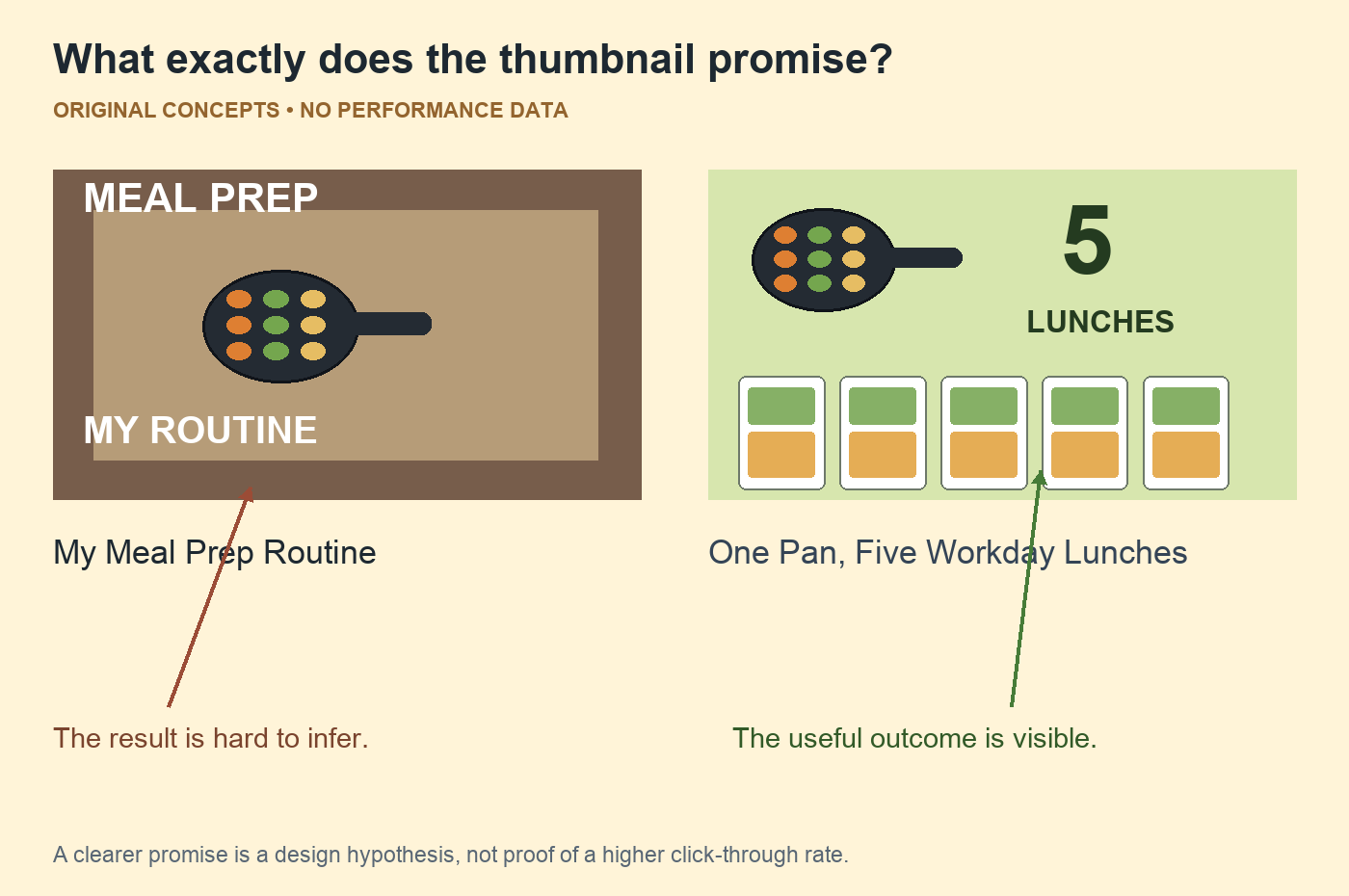
Original teaching concepts, not real channel thumbnails or an A/B test. The annotations describe creative choices; neither version has measured performance.
Notice what this comparison does not prove. It does not prove that five is a winning number, that faces are ineffective, or that a yellow background increases clicks. We are examining whether the packaging communicates the intended idea.
Try the same exercise with your next upload. Give someone the title and image without an explanation. Ask what they expect to see. If they anticipate a shopping challenge while you have filmed a recipe tutorial, you have found a mismatch before spending another hour on the edit.
Open the notebook: observations on one side, explanations on the other
The quickest way to make competitor research more useful is to stop mixing what you saw with what you think it means.
| What we can observe | What we might investigate |
|---|---|
| The finished meals appear before the introduction | Does showing the result help new viewers understand the promise? |
| The title names a quantity and a use case | Is the workday-lunch problem more compelling than a general recipe? |
| The video includes ingredient substitutions | Does flexibility make the recipe useful to a wider audience? |
| The upload substantially exceeds the channel's usual reach | Did demand, distribution, or the viewing experience differ? |
The right-hand column is where new ideas come from. It is not a list of facts about the algorithm.
If you own the channel, you can investigate further using traffic sources, retention, and audience information. If you are studying someone else's channel, those private details may be unavailable. An outside researcher cannot infer a precise retention curve from the final view count.
That limitation should change your wording. “This opening could reduce setup time” is a defensible interpretation. “This opening retained 90% of viewers” requires actual data.
Compare the breakout with an ordinary performer
Watching only viral videos is like studying only the winning tickets after a raffle. You see features of winners without learning whether the same features were common elsewhere.
Suppose you inspect twenty hypothetical cooking uploads. Four become breakouts. Three of those four use numbered titles. That sounds promising—until you learn that twelve of the sixteen ordinary performers also use numbered titles.
In this tiny invented sample, numbered titles appear on 75% of both groups. The feature does not distinguish the winners from the ordinary uploads. The example is deliberately simple; a serious study would also need to address topic, channel size, publication age, and other differences.
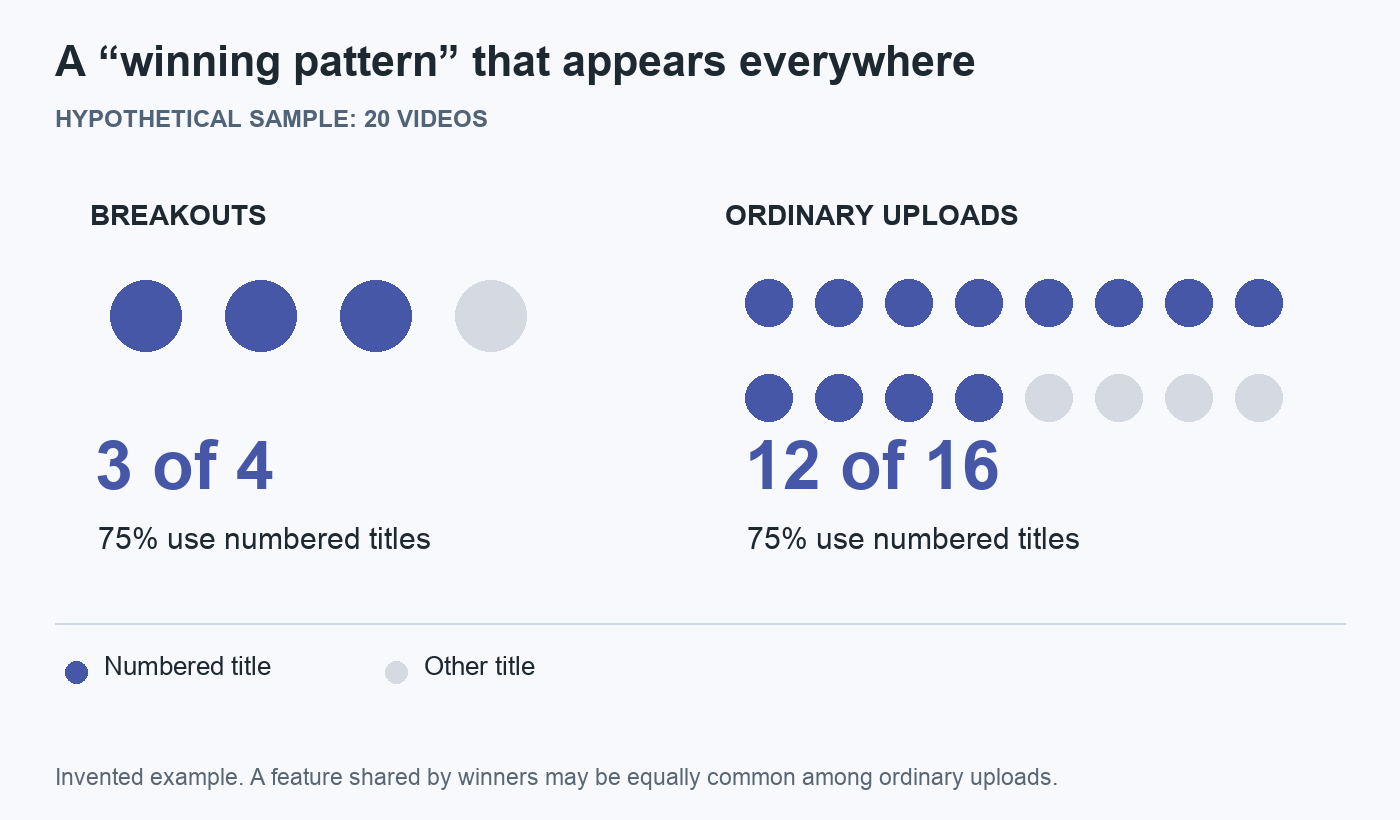
Invented sample for explaining comparison bias. Counting a feature among winners is not enough; you need a relevant comparison group.
For your own research, choose a few related videos that performed normally and examine the same details. Keep the topic, format, and viewing age as comparable as possible. Do not compare an old long-form tutorial's lifetime views with a Short published yesterday.
You do not need a giant spreadsheet to make this useful. You need enough discipline to record the cases that do not fit your favorite explanation.
Give the numbers a fair denominator
For our cooking channel, assume five earlier comparable uploads reached 6,000, 7,000, 8,000, 9,000, and 10,000 views after 28 days. Their median is 8,000. The 400,000-view breakout is fifty times that reference point.
That is a useful description of how unusual the result is. It is not a score YouTube assigns to the video. It also does not tell us whether the additional audience wants more of the creator's normal recipes.
Record the viewing window alongside the number. “400,000 views in 28 days” and “400,000 lifetime views” are different observations. Save the date when you collected public data so you can revisit the comparison honestly.
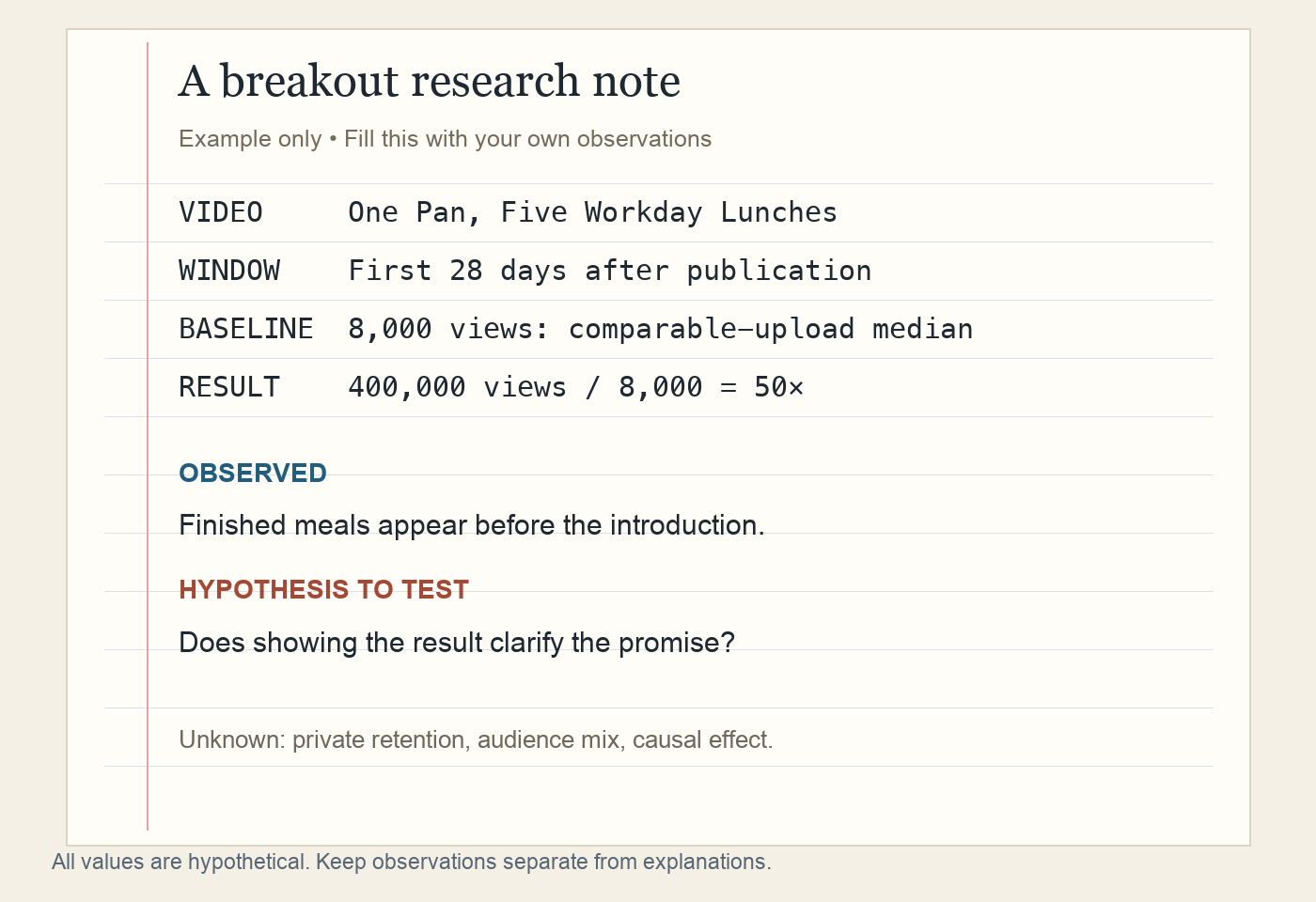
Use the worksheet structure, not the example numbers. All values shown are hypothetical.
Growwly's free Channel Audit can help identify public breakout and upload patterns before you choose examples to inspect. Use the result to narrow your research, then watch the videos. An audit cannot replace the comparison you are trying to make.
What published research adds—and what it cannot add
A breakout might spread because it gives people something worth sending to a friend. Our lunch video has an obvious possible message: “This could solve our weekday cooking problem.” That is more specific than “Here is a popular video.”
Berger and Milkman's research connected sharing with factors including emotional activation and practical usefulness. Their study examined news content and included experiments; it was not a study of today's YouTube recommendation system. Read the research.
For a creator, this suggests a useful planning question: who would send the video to whom, and why? An astonishing result, a recognizable joke, or a practical solution can each supply a different answer.
Do not turn that into a rule that every video needs outrage or a dramatic reveal. A calm explanation can be valuable to its intended audience. Research should expand the questions you ask, not force every subject into one emotional register.
YouTube's own guidance also identifies wider conditions such as topic interest, competition, and seasonality. Even a well-made Short competes with other things a particular viewer could watch. YouTube's Shorts discovery guidance.
Together, these sources help explain why copying a visible technique cannot guarantee the same reach. The audience opportunity and distribution context remain part of the story.
A Short is a different version of the idea
If our creator turns the recipe into a Short, the useful question is not “How do we squeeze the whole tutorial into less time?” It is “What complete experience can we deliver in this format?”
One version could show the five meals, demonstrate the single most useful preparation step, and reveal the finished pan. The longer video can explain ingredients, timing, storage considerations, and substitutions in greater detail.
The Short should still make sense on its own. A fast sequence that ends before anything is explained may attract starts without satisfying the reason someone continued watching.
Measurement needs the same care. YouTube changed Shorts view counting in March 2025 to include starts and replays without a minimum watch duration, while retaining engaged views in Analytics. A public Short view total therefore should not be treated as interchangeable with a long-form viewing experience. YouTube's view-count explanation.
Compare Shorts with relevant Shorts, and inspect the deeper viewing metrics available to you. A big number can identify a video worth studying without answering why it worked.
Design the follow-up before announcing the lesson
Our creator's next experiment could be “One Tray, Five Vegetarian Lunches.” That tests whether the useful audience promise extends to a related problem. It changes enough to offer something new while preserving a recognizable reason to watch.
Before filming, write the hypothesis: “Viewers may value a complete workweek outcome more than a general meal-prep routine.” Then specify what would be informative: the response to the premise, the opening, the practical explanation, and the next relevant upload.
A weaker follow-up would copy the overhead shot and title punctuation while switching to a luxury dinner that serves a different need. If it underperforms, you would not know whether the original lesson was wrong or whether you stopped testing it.
Keep the experiment affordable enough to repeat. One upload rarely settles a creative question. You want a process that improves your decisions across several attempts, including the attempts that perform normally.
The most valuable note at the end of a breakout analysis is often quite modest: “We have a better question for the next video.” That is more useful than a confident explanation you cannot verify.

The Psychology Behind Videos That Get Millions of Views
Explore the psychology of viral videos, from curiosity and emotion to clarity and payoff, with evidence-led ideas for YouTube Shorts and long-form content.
Read the post
Why Going Viral Can Kill Your Channel and How to Avoid It
Can going viral hurt your YouTube channel? Explore the risks of chasing a hit, losing focus, overspending and how to protect your creative direction.
Read the post