The Hidden Pattern Behind Ali Abdaal's Success
We audited 200 of Ali Abdaal's videos and found a repeatable two-engine system behind his growth — not luck, not charisma. Here's the breakdown.
Everyone assumes it's the productivity niche, the "doctor who quit medicine" story, or just good timing. Our audit of 200 of his videos says otherwise — there's a repeatable system underneath it, and you can run the same one.
Somewhere in Ali Abdaal's back catalogue is a 25-minute video where he reviews and ranks Harry Potter fanfiction. It has nothing to do with productivity, note-taking, or making money online — the three things his channel is supposedly "about." It still pulled in 13,000 views in its first stretch, which is a perfectly respectable number for a video that, on paper, makes zero sense for his channel.
That's the moment you realize something else is going on. Most creators assume Ali Abdaal's success comes down to a lucky niche (productivity content exploded during the pandemic), a strong personal story (Cambridge-trained doctor who left medicine to make YouTube videos), or just raw consistency. All three are true. None of them explain why a Harry Potter video works on a productivity channel.
We ran a full Channel Audit on @AliAbdaal — 200 videos, publish dates, view/like/comment counts, durations, thumbnails, and transcripts on a sample of standout uploads — to see if the growth was pattern-based or just noise. It's pattern-based. Here's what the data actually shows.
The Channel, By the Numbers
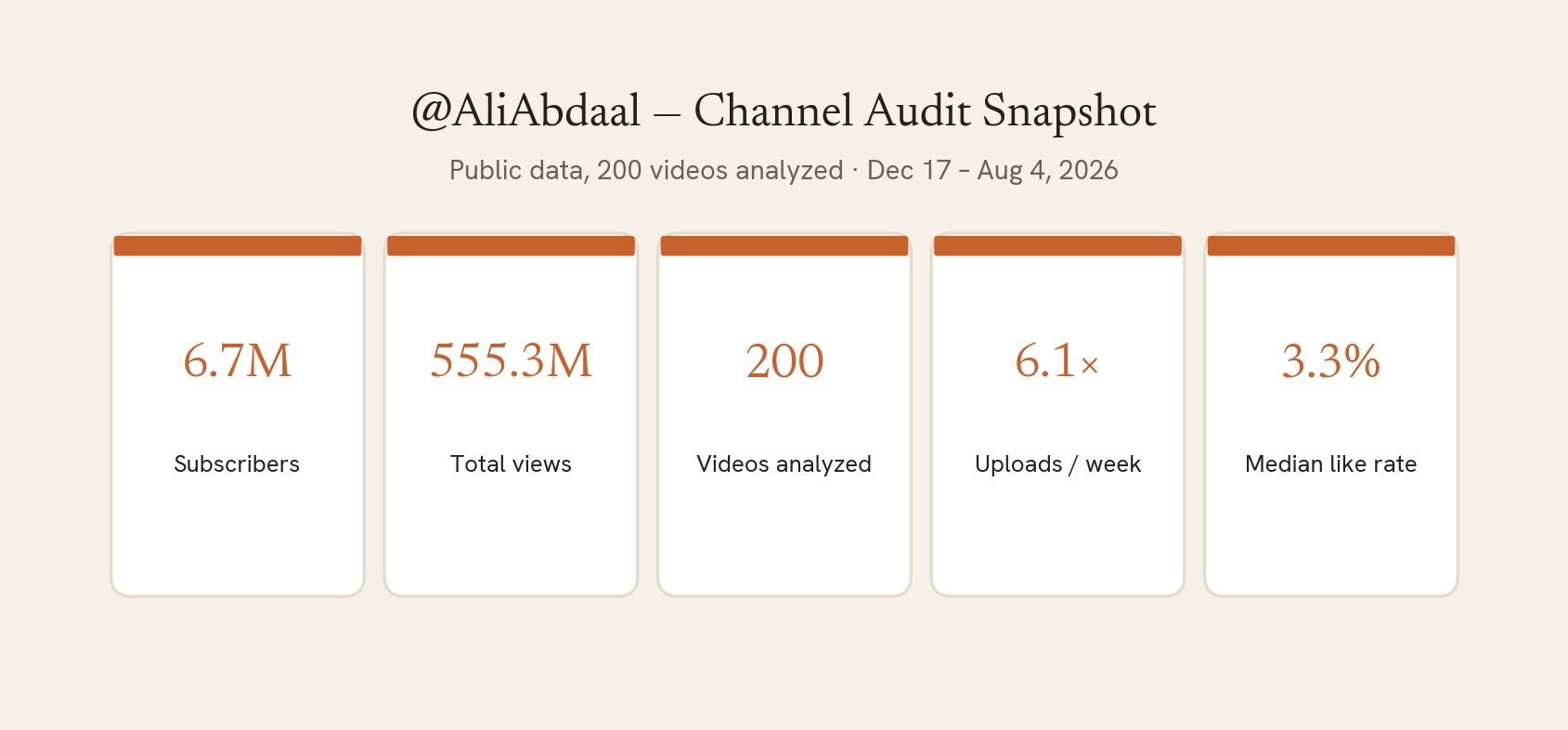
Before the pattern, the scoreboard. As of the audit window (December 2025 through early September 2026), the channel sits at:
- 6.7M subscribers
- 555.3M total views across the analyzed window
- 200 videos analyzed
- 6.1 uploads per week — a genuinely aggressive cadence for a single creator-led channel
- 3.3% median like rate — solid, not spectacular, which itself is a clue (more on that later)
Six uploads a week is the first hint that something structural is going on. Nobody scripts, films, and edits six long-form videos a week by hand. The pace only makes sense once you see what those six uploads actually are.
The Two-Engine Model Behind Every Upload
Run the durations of all 200 videos and a clean split appears almost immediately. It isn't a gradual bell curve — it's two distinct clusters with very little in between.
Engine 1 is a stream of ultra-short videos, mostly 0–2 minutes, built around a single idea and a curiosity-driven title: "Time-Saving Habits," "AI tools to use." These are cheap to produce, easy to package, and built to travel — they're the top-of-funnel hooks that pull new viewers in from Shorts and suggested feeds.
Engine 2 is the opposite: structured 15–89 minute deep dives with real frameworks — "The Ultimate Beginner's Guide to Claude Code" at 67 minutes, "The Dark Side of Getting Rich On YouTube" at 118 minutes. These are the videos that build watch time, subscriber trust, and the channel's reputation as an authority rather than a talking head.
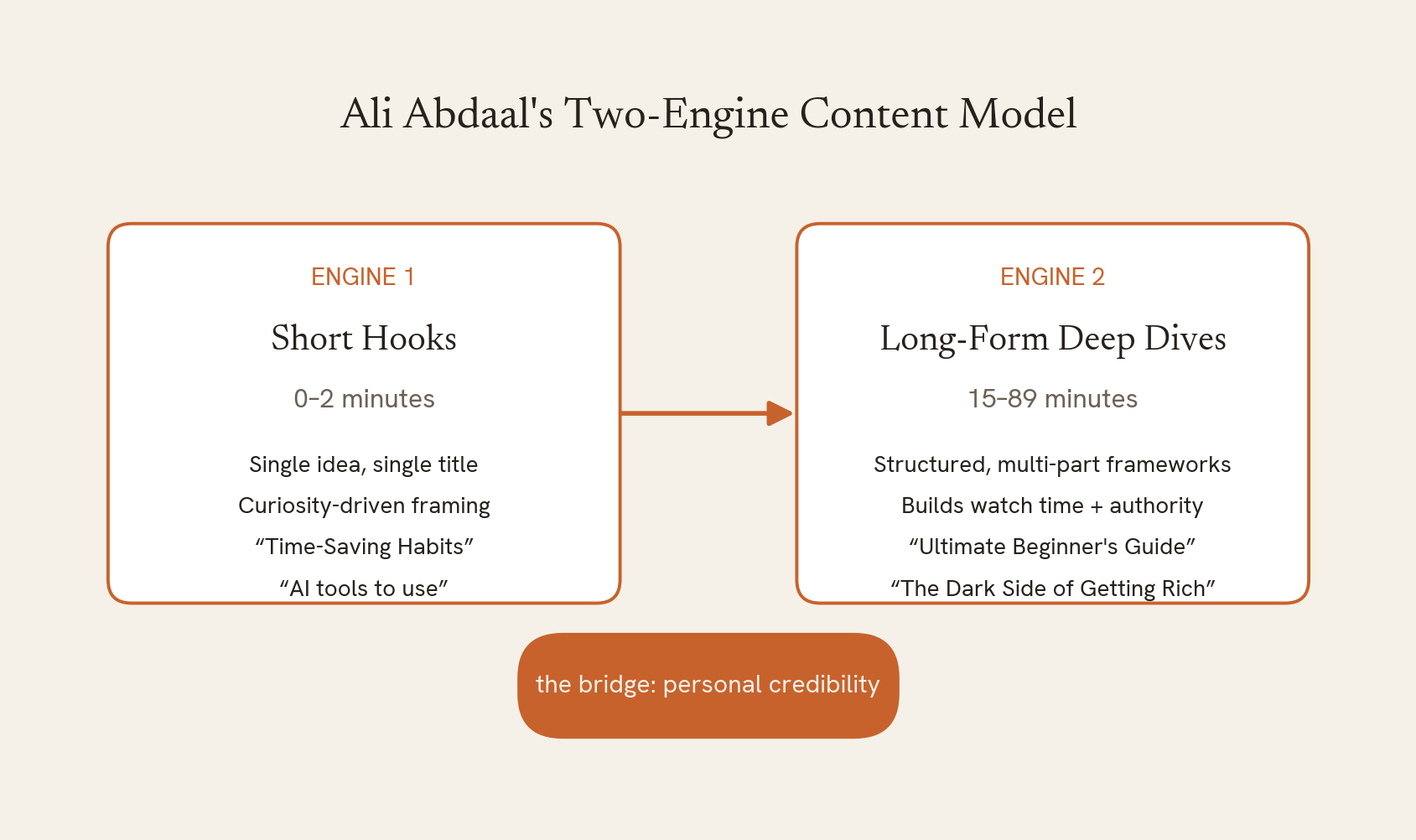
Neither engine works particularly well alone. A channel of only 90-second hooks never builds the authority to sell a course, a book, or a business. A channel of only 90-minute deep dives never gets discovered often enough to matter. Run both, on the same channel, under the same face, and each one subsidizes the other — the shorts bring in volume, the long-form converts that volume into a real audience.
This is the part most "just post consistently" advice misses: consistency isn't the pattern. The ratio between two very different formats, running in parallel, is the pattern.
The Real Bridge: Personal Credibility as the Product
Here's what actually explains the Harry Potter video. Look closely at the titles across both engines and a specific move shows up again and again: "7 Obsessive Habits That Turned Me Into a Multi-Millionaire," "I made my first $1,000,000 at 26. Here's how," "My $100K App: What I Learned."
These aren't topic titles. They're credibility titles. Every one of them ties the advice inside to something Ali has personally lived through, which does two things a generic "how to" title can't do: it makes the claim feel earned rather than theoretical, and — this is the important part — it transfers to any topic he decides to cover next. Once "doctor turned multi-millionaire entrepreneur" is the thing the audience is actually subscribed to, a video ranking Harry Potter fanfiction isn't off-topic. It's just Ali being Ali, and the audience shows up because they trust the person, not the subject line.
Key insight: the topic isn't the product on this channel — the demonstrated judgment of the host is. Once an audience trusts your judgment, you can point it at almost anything and retain a meaningful chunk of your viewership.
That's a genuinely hard asset to build, and it's the real reason this pattern isn't a shortcut. It compounds slowly, video after video, credibility claim after credibility claim, until the channel itself becomes the niche.
The "If I…" Framework That Forces a Click
Zoom into the titles again and a second, more mechanical pattern shows up — one you can actually copy this week. Across the highest-performing videos in the audit, a specific hypothetical framing keeps recurring:
- "If I Wanted to Make My First $100K in 12 months, I'd Do This" — 398,791 views
- "If I Started A Business in 2026, I'd Do This" — 234,016 views
- "If I Started YouTube from Scratch in 2026, I'd do THIS" — 165,236 views
- "If you're ambitious but lazy, watch this" — 264,494 views
The "if I…" structure works because it converts a generic topic into a decision the viewer is implicitly forced to weigh: what would I do differently, and does his answer match mine? That small bit of friction — the curiosity gap between your plan and his — is enough to push a click that a flat "How to Start a Business" title never would.
The Bracketed Franchise Trick
The third pattern is the sneakiest, because it looks like a small stylistic choice and is actually a branding strategy. At least 15 videos in the audit follow an identical naming template: "The [Concept] Paradox" or "The [Concept] Effect."
"The Intention Paradox." "The Identity Shift Effect." "The Empty Boat Paradox." "The Bamboo Tree Effect." "The Competition Paradox." "The Crab Bucket Mentality." "The Dry Well Effect."
Individually, each title sounds like a one-off psychology explainer. Stacked together, they're a mini-series with house branding — a format the audience recognizes on sight and comes back for, the same way you'd recognize an episode of a show by its title card. It's a low-cost way to manufacture a sense of "franchise" on a channel that technically covers a different topic every single video.
What Actually Made the Biggest Hits Hit
Averages are useful, but outliers tell you more about what a ceiling looks like. Here are the five standout videos from the audit, ranked by views:
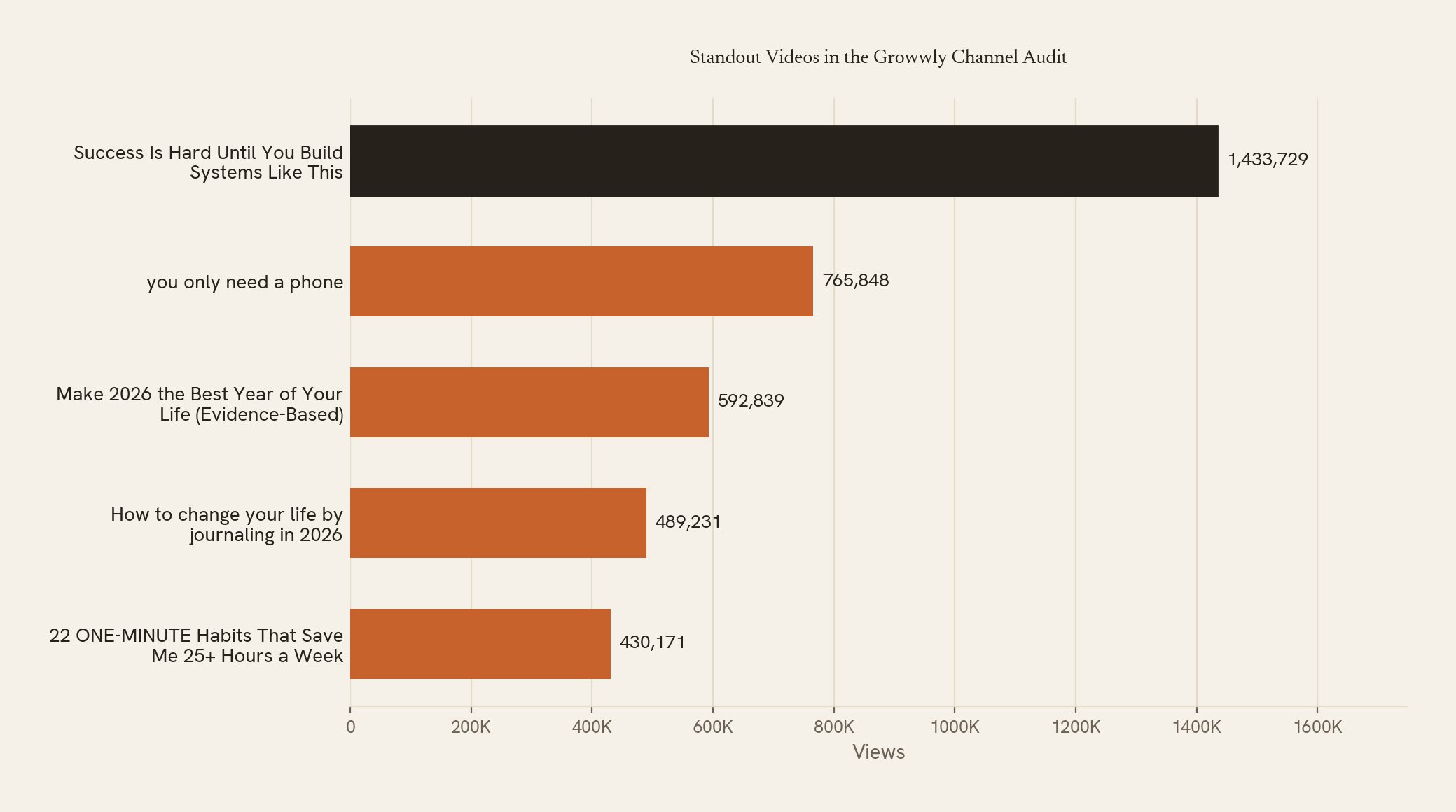
The single biggest hit, "Success Is Hard Until You Build Systems Like This" at 1.43M views, is a textbook pain-point-plus-curiosity-gap title: name the frustration ("Success Is Hard"), then promise relief without giving it away ("Until You Build Systems Like This"). At 26 minutes, the video has enough room to deliver a full framework rather than a listicle — and per the audit's comment analysis, the audience specifically wanted the how, not another motivational reminder of the what.
"you only need a phone" is worth studying for the opposite reason — it's lowercase, unpunctuated, almost thrown away. It directly neutralizes the single biggest objection an aspiring creator has (gear cost) in six words, and the comments show people acting on it immediately. Sometimes the highest-converting title on the channel is the one that tries the least hard.
"Make 2026 the Best Year of Your Life (Evidence-Based)" stacks three separate triggers into one title: a calendar-timely hook (new year), a bold promise, and a credibility parenthetical that quietly separates it from a thousand identical "new year, new you" videos. That last two words — "Evidence-Based" — are doing more work than the rest of the title combined.
How to Steal This Pattern for Your Own Channel
None of this requires Ali's subscriber count, his medical degree, or his production team. The pattern is structural, which means it's copyable at any channel size:
- Run two formats on purpose, not by accident. Decide what your short-form hook format is (under 2 minutes, one idea, curiosity title) and what your long-form authority format is (structured, multi-part, 15+ minutes). Most small channels either post only shorts and never convert that reach into subscribers, or post only long-form and never get discovered. You need both, deliberately.
- Bank credibility claims early and reuse them. Every result you can point to — a number, a before/after, a specific outcome — is a future title. You don't need "multi-millionaire at 26." You need your version of it, however small it starts.
- Borrow the "if I…" framing for your next how-to video. Instead of "How to Edit Faster," try "If I Had to Learn Video Editing From Scratch in 2026, I'd Do This." Same information, more decision tension.
- Give your recurring format a name. A bracketed series title costs nothing and turns a one-off video into a returning appointment.
- Check your own ratio before you copy anyone's title formula. Pull up your last 20 uploads and actually count the split between hook-length and authority-length content. Most creators are surprised by how lopsided it already is.
That last step is exactly what the Channel Audit tool is built for — drop in any channel URL, including your own, and it'll break down upload cadence, format mix, and breakout videos the same way we just did for @AliAbdaal. If you want an unfiltered second opinion on your thumbnails, titles, and upload habits specifically, Roast My Channel is the blunter version of the same idea. And if you'd rather have this kind of breakdown sitting in your browser while you're actually researching competitors on YouTube itself, the Chrome extension pulls the same signals — upload patterns, outlier videos, title structures — directly on top of any channel page you're already browsing.
The Limits of the Pattern
Worth being honest about what this audit can't tell you. It's built on public data — titles, dates, cumulative views, likes, comments, durations, and transcripts for a handful of selected videos. It doesn't include retention curves, average view duration, traffic source breakdowns, or subscriber growth deltas, because none of that is publicly available for a channel that isn't yours. So the growth drivers above are Growwly's inference from the patterns in the public data, not a guarantee that any single title formula will replicate Ali Abdaal's results on a different channel with a different audience and a different amount of accumulated trust.
That trust is the part that's genuinely not shortcuttable. Ali Abdaal has been uploading in some form since 2017. The credibility bridge that lets him post a Harry Potter ranking video on a productivity channel took years and hundreds of videos to build. The title formulas and format ratio are learnable in an afternoon; the trust they're built on top of isn't.
Final Thoughts
Strip away the medical degree and the productivity-guru branding, and what's left is a fairly mechanical system: a high-frequency hook engine feeding a lower-frequency authority engine, bridged by titles that sell the host's judgment as much as the topic, wrapped in a couple of cheap, repeatable framing tricks. That system is what's actually behind the growth curve — not a niche that happened to blow up, and not charisma you either have or don't.
Every creator on YouTube is sitting on some version of this same raw material — a set of results, a format they're already good at, a topic they could turn into a recurring bit. The pattern isn't unique to one channel. It's just rarely run on purpose.
Want the same breakdown on your own channel? Run a free Channel Audit, or add the Chrome extension to see these signals on any channel you visit.

The Psychology Behind Videos That Get Millions of Views
Explore the psychology of viral videos, from curiosity and emotion to clarity and payoff, with evidence-led ideas for YouTube Shorts and long-form content.
Read the post
Why Going Viral Can Kill Your Channel and How to Avoid It
Can going viral hurt your YouTube channel? Explore the risks of chasing a hit, losing focus, overspending and how to protect your creative direction.
Read the post