How Long Does It Take for YouTube Videos to Blow Up?
How long does it take for YouTube videos to blow up? Learn what affects growth, which metrics to check, and what to do when a video starts slowly.

You upload a video, refresh YouTube Studio, and wait. A few views arrive. Then everything slows down. Was the idea wrong, or does the video simply need more time?
There is no fixed deadline for a YouTube video to blow up. It might gain attention soon after publishing, grow gradually, or find a larger audience much later. A quiet first day does not tell you how the video will perform over its lifetime. YouTube explicitly acknowledges that older videos can take off.
That uncertainty can feel frustrating, especially when you are starting a channel. But it also gives you a better question to work with: What does this video's performance tell me to improve next?
This guide explains how to think about timing, read the right signals, and respond to a slow start without turning every upload into a countdown.
What does “blowing up” actually mean?
For this guide, a video is “blowing up” when it attracts substantially more attention than your usual uploads. This is a practical working definition, not a YouTube classification.
Imagine your recent tutorials each received about 300 views during their first week. A new tutorial reaches 6,000 in the same period. That is a meaningful breakout for your channel, even if it never reaches a million views. These numbers are hypothetical; they illustrate why your baseline matters.
Compare videos at the same age. A two-day-old upload and a three-year-old tutorial have had different opportunities to accumulate views. Also compare similar formats and subjects wherever possible.
If you have only published one or two videos, you do not yet have a reliable personal baseline. Treat those uploads as early observations. Write down what you tried, who the video was for, and what viewers responded to before declaring the channel a success or failure.
How long should you wait before judging a video?
Separate the time you allow for discovery from the time you schedule for analysis. You cannot set the first, but you can control the second.
The schedule below is an editorial review routine, not a measured average time to go viral or a description of YouTube's internal distribution stages.
| Review checkpoint | What to investigate | A useful response |
|---|---|---|
| First 24 hours | Is the upload public, playable, and presented accurately? | Fix obvious publishing errors; avoid conclusions from a tiny sample. |
| Around days 2–3 | Is enough data available to identify a clear issue? | Review traffic sources and available retention data. |
| Around day 7 | How does it compare with similar uploads at the same age? | Record one explanation worth testing. |
| Around day 28 | Has discovery continued, slowed, or shifted to another source? | Choose whether to improve the packaging, create a follow-up, or move on. |
| Later, when relevant | Has interest in the subject changed? | Revisit useful older videos and check their accuracy. |
Low-volume channels may need longer to gather useful evidence. YouTube advises creators to avoid judging click-through rate immediately after uploading or before receiving enough impressions. Separately, audience retention data typically takes one to two days to process.
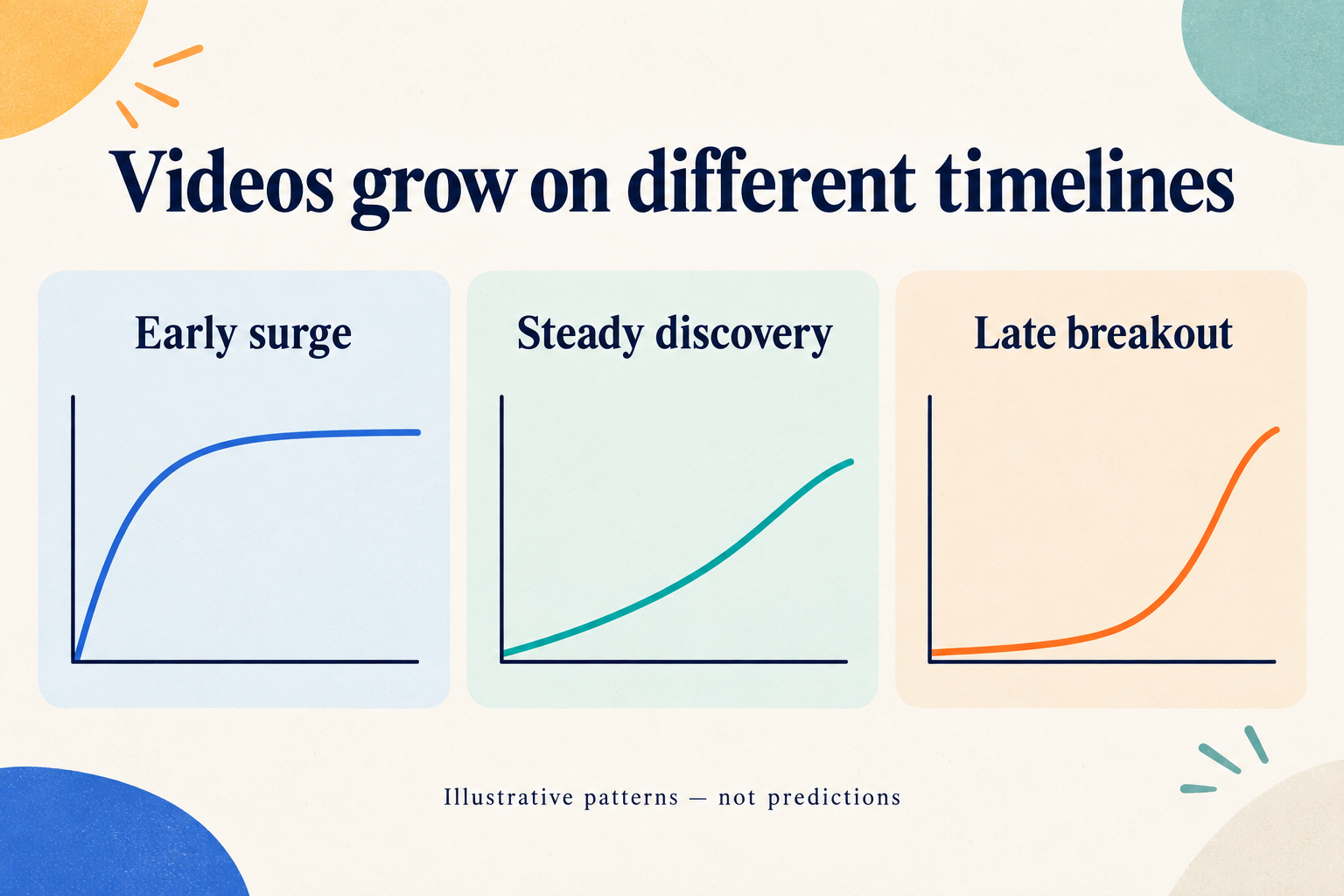 Videos can follow different paths. These curves illustrate possibilities; they are not measured results or forecasts.
Why can a video take off later?
YouTube identifies several reasons older uploads can attract fresh attention: renewed interest in their topic, new viewers exploring a channel's back catalog, stronger viewer response to recommendations, or a new episode sending people to earlier installments. Why older videos take off
Consider a hypothetical tutorial about improving webcam lighting. Its initial audience might be small. Later, a related video could introduce viewers to the creator's earlier tutorials. A seasonal wave of interest in home-office setups could also make the subject newly relevant.
The lesson is to maintain a useful library. Check that older advice still works, keep titles accurate, and make related videos easy to explore. Patience is more productive when you also keep publishing work that serves the same audience.
What affects whether a YouTube video gains momentum?
YouTube describes three broad groups of performance signals: appeal, engagement, and satisfaction. In practical terms, these concern whether people choose a video, continue watching, and enjoy the experience.
Use those categories to organize your thinking, without reducing the whole system to one score.
1. The topic and the audience you are trying to reach
A strong starting point is a specific viewer with a specific reason to watch. “My desk setup” leaves that reason open. “A small-desk recording setup for beginner creators” tells you who the video is for and what it should deliver.
Before filming, complete this sentence: “After watching, this person will be able to ___.” For entertainment, replace the outcome with a clear experience: a surprising reveal, an absorbing story, or a satisfying challenge.
Specificity also helps you judge results fairly. A tutorial solving an uncommon software problem and a broad entertainment challenge serve audiences of different sizes. YouTube notes that niche demand and competition can limit impressions even when a video's metrics look strong.
2. The title and thumbnail
Think of these as the promise viewers see before watching. They should make the subject understandable and give the right person a reason to care.
For example, “Camera Settings Explained” might become “Fix Grainy Indoor Video: 3 Camera Settings to Check.” That revision is only appropriate if the video actually explains those three settings and their limitations.
Try a simple planning exercise: draft three honest titles, sketch one thumbnail idea for each, and ask which combination communicates the value most clearly at a glance. Avoid adding claims you cannot demonstrate just to make the title sound bigger.
For an outside perspective, try our free AI tool, Roast My Channel. It reviews thumbnails, titles, and upload habits. Use its feedback to generate an improvement hypothesis, then check that hypothesis against your own audience data.
3. What happens after someone starts watching
A compelling promise needs a matching opening. If the title promises a practical fix, show the problem and begin demonstrating the fix before adding background information.
In your next script, mark every sentence before the first useful demonstration. Which sentences help viewers understand it? Which only explain why you decided to make the video? Move or remove the latter where appropriate.
YouTube's retention report can help identify where people skip or leave. Its intro measure shows the percentage still watching after 30 seconds. A spike deserves inspection too: it can reflect renewed interest or a section viewers needed to replay because it was unclear.
4. How viewers discover the video
YouTube Analytics separates sources such as search, browse features, suggested videos, and external traffic. Check the video's Reach report to see which sources are contributing.
For a search-focused tutorial, start with the actual question a viewer needs answered. YouTube says search considers relevance, engagement, and quality, including how the title, description, and video content match a query.
Use that information to write naturally. A description should explain the problem, the solution, and useful context. Repeating the same keyword in every sentence makes the description harder to use.
How long does it take for YouTube Shorts to blow up?
Do not give a Short an automatic expiration date. YouTube's Shorts discovery guidance does not provide a universal hour or day when growth must happen.
It does explain that ranking considers whether viewers choose to watch, average view duration, average percentage viewed, and satisfaction signals such as likes and survey responses. Topic interest, competition, and seasonality also affect exposure.
For your next Short, make the first frame understandable without a long explanation. Build around one clear idea, remove unnecessary setup, and make sure the ending delivers what the beginning suggests. Compare that approach with similar Shorts you have made, rather than treating a viral clip from another niche as your required benchmark.
A current measurement detail matters here: YouTube introduced Shorts views based on starts and replays in March 2025. Its August 2026 update states that views now count when playback starts across Shorts, long-form videos, and live streams.
Consequently, be careful when comparing today's headline view count with older screenshots or reports. Inspect the metric definitions and time periods. For Shorts, YouTube retains engaged views to help creators compare how many viewers continued watching.
What should you do when your video is not blowing up?
Start with a diagnosis, then choose a small, deliberate response. The possibilities below are questions to investigate, not proof of why a particular video stalled.
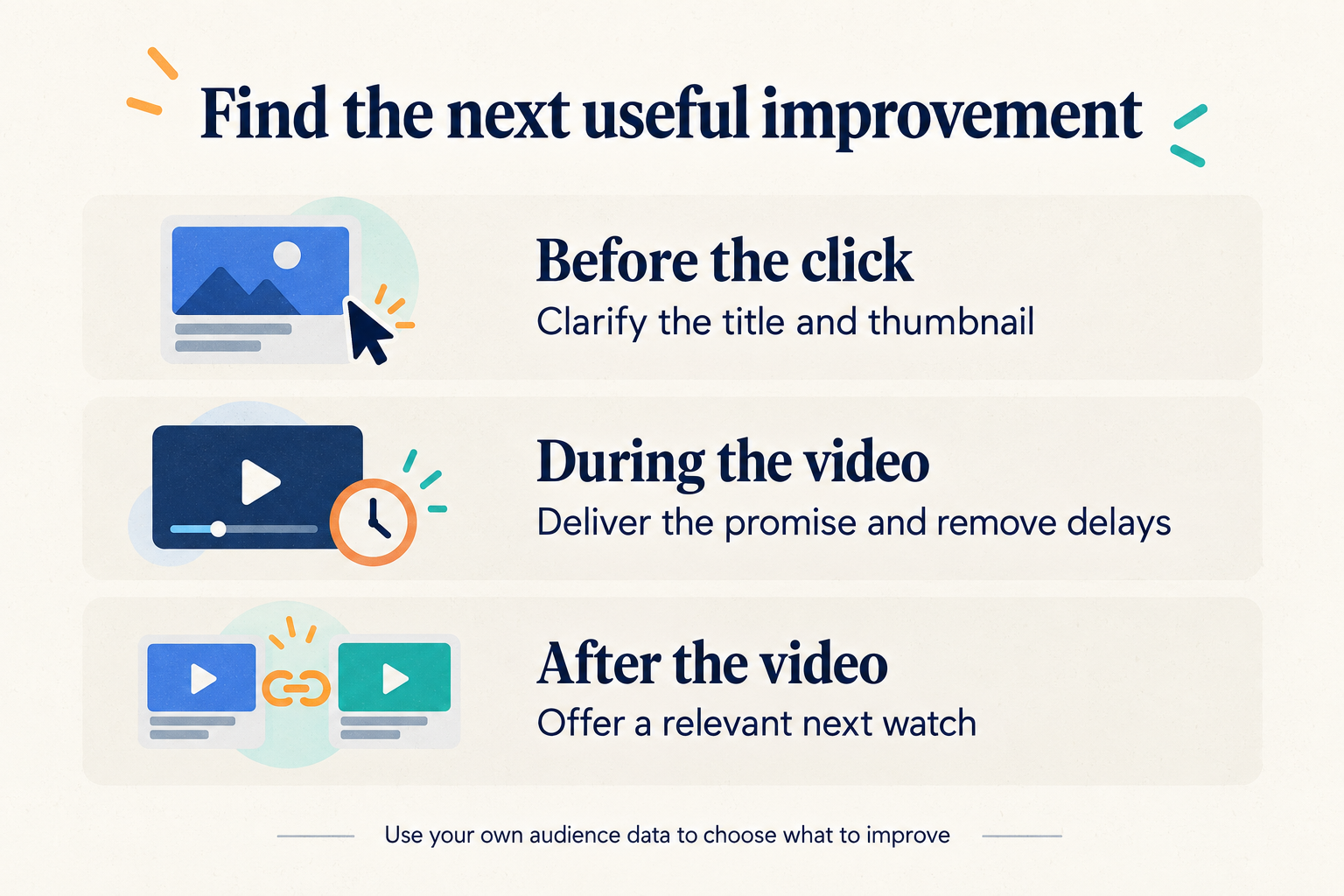 Choose an improvement based on the problem your audience data suggests.
If there is very little data, collect more evidence
First check the basics: visibility, playback, sound, and whether the title describes the actual video. If those are correct, continue with your next planned upload.
Keep a short learning log with the video's intended audience, central promise, opening approach, and review date. This prevents a slow afternoon from becoming an entirely new channel strategy.
If people see the thumbnail but rarely choose the video, review the promise
Read the title without any background knowledge of your channel. Is the benefit understandable? Does the thumbnail communicate one idea? Would the intended viewer recognize the problem or subject?
Be cautious about blaming the packaging from CTR alone. That metric changes with audience and traffic source, and a broader audience can bring a lower CTR alongside greater reach.
If you make a change, record what you changed and why. Treat subsequent performance as evidence to interpret, rather than automatic proof that the change caused every new view.
If people begin watching and quickly leave, inspect the opening
Watch the video as someone who clicked for the first time. Look for an audio problem, an unexplained term, a long introduction, or a mismatch between the promised result and the actual content.
Use what you find to rewrite your next opening. For example, replace a minute of personal context with a brief demonstration of the finished result, followed by the steps needed to achieve it.
If one topic works better, investigate the next question
Read comments for unresolved problems. A successful video about recording clear audio might lead naturally to a follow-up about reducing room echo. Plan a video that answers that next question in full.
Our free AI-assisted Competitor Gap Report offers another starting point by comparing your channel with a competitor and highlighting a gap. Choose a relevant peer, then use the comparison to brainstorm original ways to serve your audience.
For research while browsing YouTube, the Chrome extension brings channel audits, AI chat, and estimated performance signals onto video and channel pages. Use those signals as research prompts. They are not YouTube's private analytics or guarantees that a video will go viral.
Common questions about videos going viral
Can a video blow up after a month?
Yes. A month is a useful review checkpoint, not a cutoff; older videos can attract fresh attention.
Should I delete and reupload a video with low views?
Our recommendation is to diagnose the issue first. Low views alone are a weak reason to discard an upload. If you discover a serious factual error or a broken edit, address that specific problem; otherwise, consider an accurate packaging improvement and apply your lessons to the next video.
Is there a CTR or retention percentage that guarantees virality?
No universal target should be treated as a guarantee. YouTube says there is no single most important metric and no universal “good” benchmark across topics and formats. Compare your results with your own history and goals.
Does posting at the perfect time make a video blow up?
YouTube says publish time is not known to affect long-term video performance, although audience activity can help early viewership. Timing is relevant for live streams and Premieres.
How often should I upload while waiting for a breakout?
Choose a schedule that leaves room for planning, production, and learning. For Shorts specifically, YouTube says there is no minimum posting cadence required for good performance. Use a sustainable routine you can improve, rather than filling a calendar at any cost.
Give each upload a purpose beyond going viral
Before your next upload, write down one audience, one promise, and one improvement you want to test. Schedule a review, then return to creating.
A breakout would be welcome. But a useful result can also be a clearer title, a stronger opening, or a question that leads to your next worthwhile video. Those are things you can act on while the view count is still moving slowly.
If you need a place to begin, explore our free creator tools and choose one suggestion to evaluate. Give viewers something worth watching, learn from their response, and let your next upload reflect what you learned.

The Psychology Behind Videos That Get Millions of Views
Explore the psychology of viral videos, from curiosity and emotion to clarity and payoff, with evidence-led ideas for YouTube Shorts and long-form content.
Read the post
Why Going Viral Can Kill Your Channel and How to Avoid It
Can going viral hurt your YouTube channel? Explore the risks of chasing a hit, losing focus, overspending and how to protect your creative direction.
Read the post