How Long Does It Really Take to Grow on YouTube? (2026 Roadmap)
A realistic, month-by-month roadmap for how long it actually takes to grow a YouTube channel from 0 subscribers — with real data, monetization milestones, and what to do at each stage.

You uploaded your first video three weeks ago. It has 41 views. Fourteen of them are probably you, checking if the thumbnail looks right on mobile.
So you Google it: "how long does it take to grow on YouTube?" And you get two kinds of answers. Either a creator who blew up in 30 days with a lucky viral Short, or a vague "it depends, just be consistent!" that tells you nothing about what to actually expect next month, or the month after that.
Here's the honest version: growth on YouTube is real, predictable, and slower than the highlight reels suggest — but it follows a pattern. This post breaks that pattern into a month-by-month roadmap, backed by actual data from thousands of channels, so you know what "normal" looks like at every stage and whether you're actually behind or right on schedule.
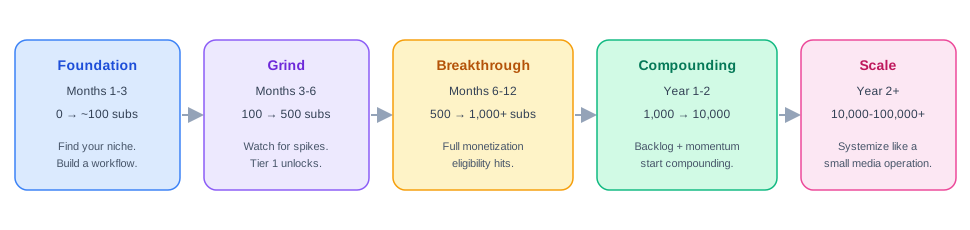 Every channel moves through the same five phases — the difference is how long you spend in each one.
The Short Answer
For a brand-new channel posting consistently, most creators reach their first 1,000 subscribers somewhere between 6 and 18 months, with the wider average across all niches sitting closer to 12-15 months. Niche-focused channels with strong titles and thumbnails often do it in 3-6 months. Channels with no clear topic or inconsistent uploads frequently take two years or more — or never get there at all.
That's the average. Your actual timeline depends on a handful of factors you can mostly control, which is the part nobody puts in the headline.
What Actually Determines Your Timeline
Before the roadmap, it helps to know what's actually steering the clock. Four things matter far more than luck:
- Niche competitiveness. A tightly defined topic with clear search demand (a specific software tutorial, a narrow hobby, a local service) gets discovered faster than a general "lifestyle vlog" with no defined audience.
- Upload consistency. YouTube's recommendation system needs repeated signals to understand who your content is for. One video a month barely gives it anything to work with; one video a week builds a pattern it can act on.
- Retention and CTR. Click-through rate gets someone to press play. Average view duration tells YouTube whether that click was worth recommending again. Channels that nail both compound faster than channels that only chase views.
- Format mix. Channels that pair Shorts (for discovery) with long-form (for depth and watch-hour accumulation) tend to build both an audience and monetization eligibility faster than channels that only do one.
None of these guarantee a timeline on their own. Together, they explain almost all of the difference between a channel that hits 1,000 subscribers in four months and one that's still at 200 after two years.
The Month-by-Month YouTube Growth Roadmap
Months 1-3: The Foundation Phase (0 → ~100 subscribers)
This is the slowest, quietest, most-abandoned phase — and also the most important. Views are low, mostly friends, family, and the occasional stranger who found you through search. Nothing here is a failure signal.
What you should actually be doing: nailing your niche, testing 3-5 title/thumbnail formats, and building a repeatable production workflow so week 10 doesn't feel as exhausting as week 1. Most channels that quit, quit here — precisely because the growth curve genuinely looks flat from the inside.
Months 3-6: The Grind Phase (~100 → 500 subscribers)
The algorithm now has enough data points to start testing your videos with small pockets of non-subscribers. You'll notice occasional spikes — a video that does 3-4x your normal views for reasons that aren't always obvious. Pay attention to which ones spike; that's YouTube telling you what it thinks you're good at.
This is also when creators typically unlock YouTube's Tier 1 Partner Program access (500 subscribers plus 3,000 watch hours or 3 million Shorts views in 90 days), which opens fan-funding features like Super Thanks and Memberships — a small but real signal that the channel is becoming a real, monetizable entity.
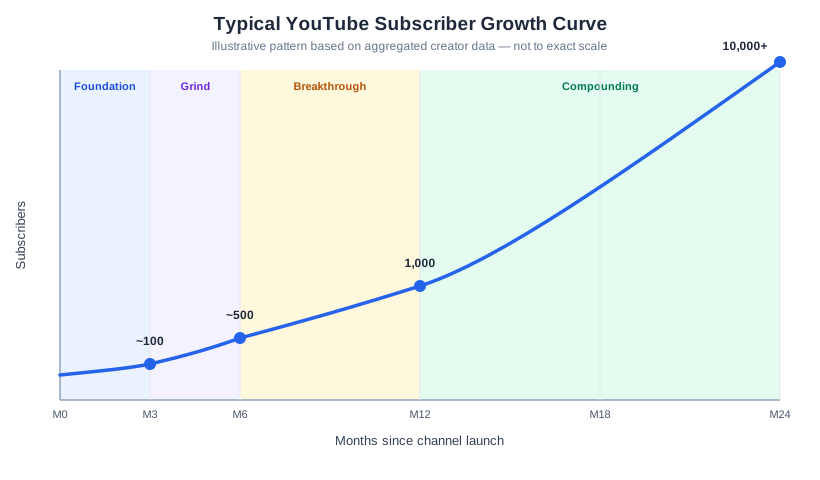 Growth rarely looks like a smooth line — expect flat stretches punctuated by sudden jumps when one video breaks through.
Months 6-12: The Breakthrough Window (500 → 1,000+ subscribers)
Statistically, this is where most first-time creators cross the 1,000-subscriber line — the point that unlocks full monetization (1,000 subscribers plus either 4,000 watch hours in the past 12 months, or 10 million Shorts views in 90 days). Research aggregating growth data across thousands of channels puts the average time to 1,000 subscribers at roughly 12-15 months, with wide variation — some niche, SEO-strong channels do it in a third of that time, while unfocused channels take two to three times as long.
One pattern worth knowing: a meaningful share of channels don't hit 1,000 subscribers until they've published well over 100 videos. Subscriber count tends to track total published videos and format consistency more tightly than it tracks how "good" any single video is.
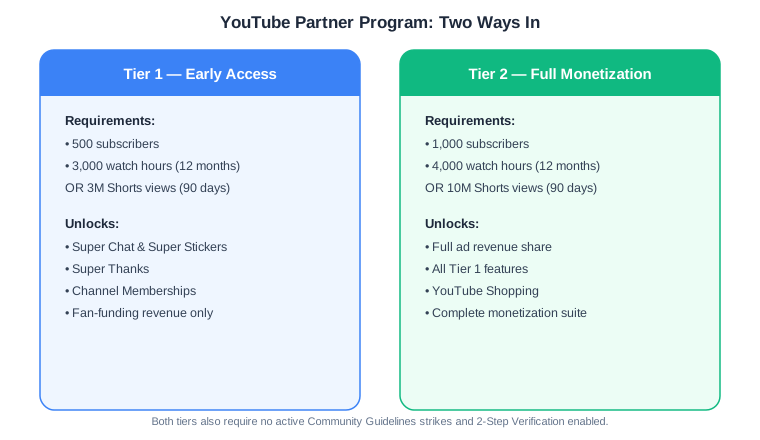 Tier 1 gets you fan-funding early; Tier 2 is the one that actually turns on ad revenue.
Year 1-2: The Compounding Phase (1,000 → 10,000 subscribers)
This stage typically moves faster than the previous one, for a simple reason: you now have a backlog of videos that YouTube can keep recommending, a clearer sense of your audience, and (usually) better retention from months of iteration. Many creators describe this as the point where growth stops feeling like pushing a boulder and starts feeling like it has its own momentum.
Year 2 and Beyond: Scaling Past 10,000-100,000+
Past 10,000 subscribers, growth becomes less about "will the algorithm notice me" and more about scaling a working system: better production value, possible collaborations, and treating the channel like a small media operation rather than a hobby. This is also usually when meaningful ad revenue starts — most creators report the income that changes decisions (not just pocket money) begins somewhere in the 10,000-50,000 subscriber range, depending heavily on niche and audience geography.
How to Know If You're Actually On Pace
The roadmap above is a guide, not a verdict — the honest next question is always "okay, but am I on track, given my specific niche and numbers?" That's a harder question to answer by eyeballing your own analytics, because you have no benchmark to compare against.
This is exactly the gap Growwly's free Channel Audit tool was built to close — it looks at your actual channel data (upload consistency, retention patterns, thumbnail CTR, and niche context) and tells you, in plain terms, where you genuinely stand versus similar channels, instead of leaving you guessing from vanity metrics alone. If revenue timing matters more to you than subscriber count, the RPM Estimator does the same diagnostic work specifically for monetization readiness.
Why Some Channels Stall Longer Than They Should
A handful of avoidable habits stretch this timeline far beyond the averages above:
- Niche-hopping. Switching topics every few weeks resets the algorithm's understanding of your channel every time.
- Inconsistent uploads. Sporadic posting (a burst of five videos, then a two-month gap) is worse for growth than a slower but steady one-a-week rhythm.
- Ignoring thumbnails and titles. Great content behind a weak thumbnail simply doesn't get clicked, and YouTube can't recommend a video nobody clicks.
- Chasing every trend. Trend-jumping without a throughline confuses new viewers about what your channel is actually "about," which hurts subscribe rate even when views are healthy.
Fixing any one of these tends to move a stalled channel more than any single "growth hack" video ever will.
Frequently Asked Questions
Is it too late to start a YouTube channel in 2026? No. YouTube's own data shows the platform continues to add active channels and viewing hours every year. Competition is real, but so is demand — the opportunity has shifted toward narrower niches and stronger production habits rather than disappearing.
How many videos does it actually take to grow? There's no fixed number, but data from multiple creator-analytics platforms suggests the average channel needs well over 100 uploads to cross 1,000 subscribers. Consistency of format matters more than any individual video's performance.
Can you skip the slow early phase? Not entirely, but you can shorten it — tightening your niche, studying competitor titles and thumbnails before you publish (not after), and using Shorts strategically for discovery all compress the foundation phase.
Does niche matter more than consistency? They work together. A strong niche with weak consistency plateaus; strong consistency in a vague niche wanders without traction. The fastest-growing channels usually get both right at once.
The Bottom Line
Most YouTube growth timelines fail not because the content wasn't good enough, but because creators expected month 2 to look like month 14 and quit before the compounding started. If you're three months in with 60 subscribers, you're not behind — you're on schedule for what this actually looks like for almost everyone.
Want a clearer picture of exactly where your channel stands right now? Run a free Channel Audit and get a plain-English breakdown of what's working, what's holding you back, and what to fix first.

Why Kurzgesagt Gets So Many Returning Viewers
Kurzgesagt uploads just twice a month yet keeps 25.4M subscribers coming back for more. Here's the exact retention system behind it, backed by data — and how any creator can borrow it.
Read the post
The Ultimate YouTube Publishing Checklist
Want your videos to rank higher? Discover the ultimate YouTube publishing checklist. Learn the exact SEO and upload steps to guarantee your content gets seen.
Read the post